
Xi’an Travel Guide: A Detailed Itinerary to Explore the Ancient City’s Charm
A Traveler’s Guide to Xi’an: Savor the Delights & Capture the Beauty Life is about savoring the good things, and for those…
A Traveler’s Guide to Xi’an: Savor the Delights & Capture the Beauty
Life is about savoring the good things, and for those who love to travel, beauty is always waiting around the corner. If you’re planning a trip to Xi’an (西安), and unsure where to begin your adventure, take a look at this guide!
Exploring the Ancient Capital
Xi’an (西安), the former capital of numerous dynasties, offers a wealth of historical and cultural treasures. Here are a few must-see destinations:
- Terracotta Army (兵马俑): Undoubtedly the most famous attraction, this UNESCO World Heritage site showcases the incredible terracotta sculptures that accompanied Emperor Qin Shi Huang in the afterlife.
- City Wall (城墙): Cycle or walk atop the well-preserved city wall for stunning panoramic views of the modern city juxtaposed against ancient history.
- Giant Wild Goose Pagoda (大雁塔): A majestic Buddhist pagoda with a rich history, offering a glimpse into the Silk Road’s influence.
- Muslim Quarter (回民街): Immerse yourself in the vibrant atmosphere of the Muslim Quarter, a bustling hub of delicious street food and unique cultural experiences.
- Shaanxi History Museum (陕西历史博物馆): Delve into the fascinating history of Shaanxi province through an extensive collection of artifacts.
- Huaqing Palace (华清宫): Explore the luxurious hot springs and historical significance of this imperial hot spring resort, famed for its connection to the legend of Emperor Xuanzong and Yang Guifei.
A Culinary Journey
As the saying goes, “Life is short, so savor the food and appreciate the beauty.” Xi’an offers a remarkable culinary landscape:
- Roujiamo (肉夹馍): Known as the “Chinese Hamburger,” this is a must-try!
- Biang Biang Noodles (油泼面): Famous for its unique, wide noodles and delicious sauce.
- Yangrou Paomo (羊肉泡馍): A hearty and flavorful soup with hand-shredded bread.
- Persimmon Cakes (柿子饼): A local specialty, these sweet and savory treats are a delightful taste of Xi’an.
Enjoy your journey through Xi’an, and create unforgettable memories!
How to Experience Xi’an (西安怎么玩)
Here’s a guide on experiencing Xi’an (西安), keeping the original Chinese phrasing as a reference:
Must-See Historical Sites (必看历史遗迹)
- Terracotta Army (兵马俑): Undoubtedly the highlight of Xi’an. Allocate at least half a day to explore the three pits and the museum. Be prepared for crowds!
- City Walls (城墙): Rent a bike and cycle the entire length of the ancient city walls for a unique perspective of Xi’an. Walking is also an option.
- Big Wild Goose Pagoda (大雁塔): A stunning Buddhist pagoda with a rich history. Explore the surrounding Tang Dynasty Show area.
- Shaanxi History Museum (陕西历史博物馆): A world-class museum showcasing the long and fascinating history of Shaanxi province. Reservations are highly recommended.
- Xianling Mausoleum (玄灵陵): A well-preserved Tang Dynasty imperial tomb, offering a quieter experience compared to the Terracotta Army.
- Small Wild Goose Pagoda (小雁塔): Less famous than the Big Wild Goose Pagoda, but still worth a visit for its beauty and tranquility.
Food Experiences (美食体验)
- Muslim Quarter (回民街): A vibrant and bustling area brimming with street food. Don’t miss the Rou Jia Mo (肉夹馍 – “Chinese Hamburger”), Yangrou Paomo (羊肉泡馍 – Lamb Soup with Bread), and various skewers.
- Dumplings (饺子): Xi’an style dumplings are unique and delicious. Look for local restaurants specializing in them.
- Biang Biang Noodles ( biáng biáng 面): A famous Xi’an specialty – incredibly thick noodles with a savory sauce. (The name is notoriously difficult to pronounce!)
- Persimmon Cakes (柿子饼): A sweet and chewy treat made with persimmon.
Other Activities (其他活动)
- Tang Dynasty Show (唐乐宫): A lavish performance showcasing the music and dance of the Tang Dynasty.
- Great Mosque (清真大寺): One of the oldest and most important mosques in China, blending Chinese and Islamic architecture.
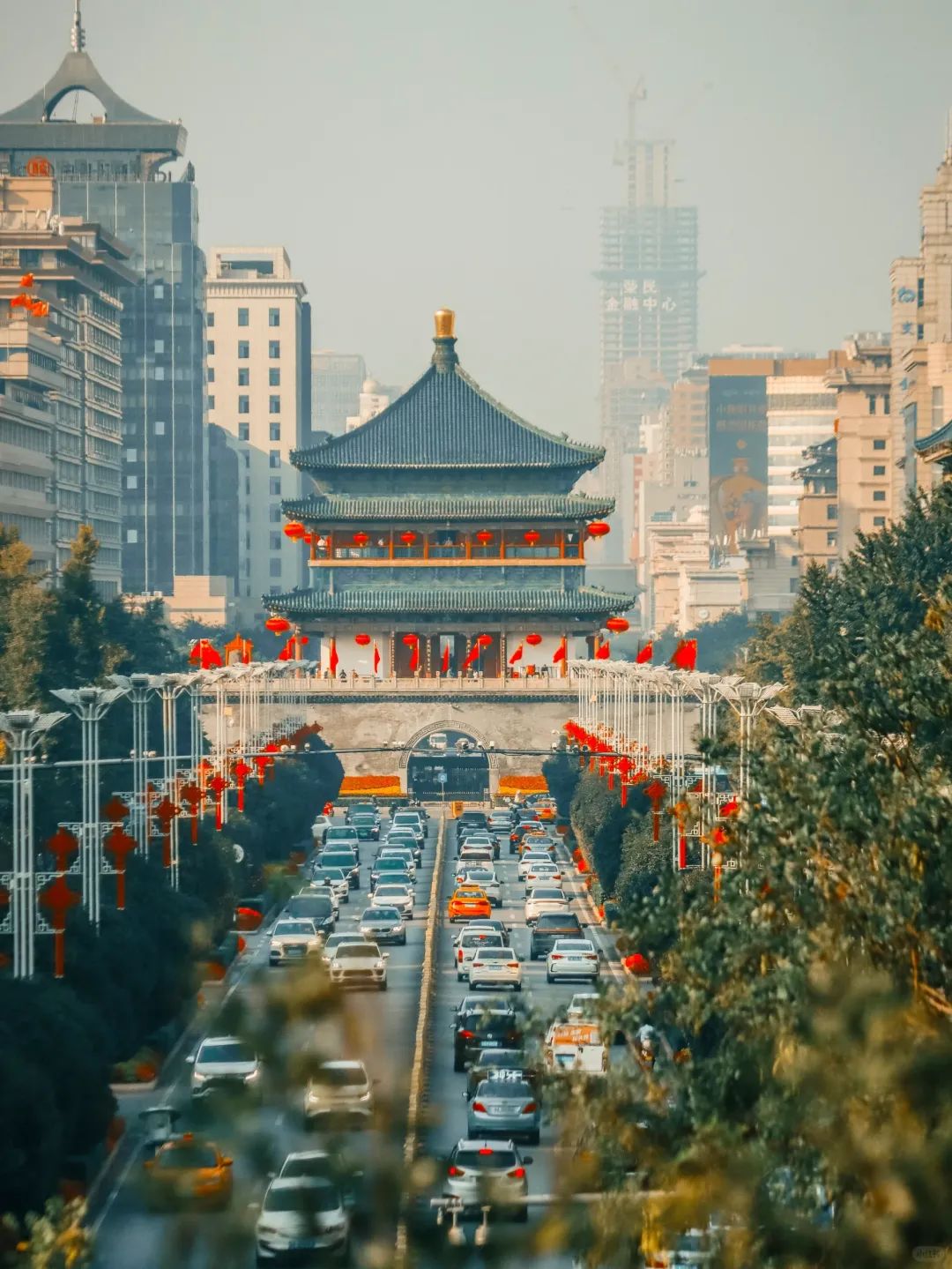
- Bell Tower (钟楼) & Drum Tower (鼓楼): Iconic landmarks in the city center. Enjoy the views from the top.
- Shopping on Yongkang Pedestrian Street (永康步行街): A modern street filled with restaurants, bars, and shops.
Enjoy your trip to Xi’an (西安)!
Day 1: Exploring Xi’an
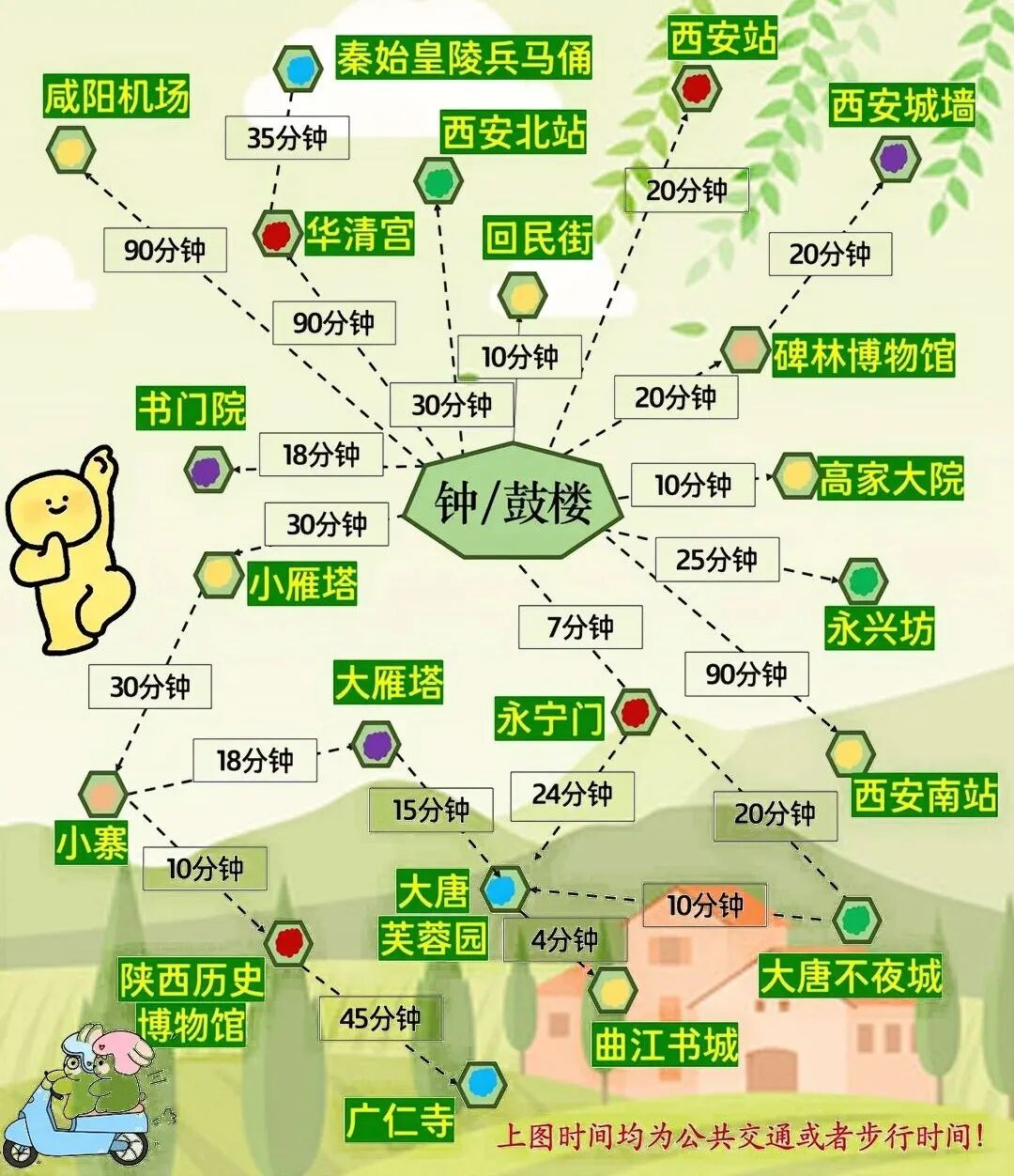
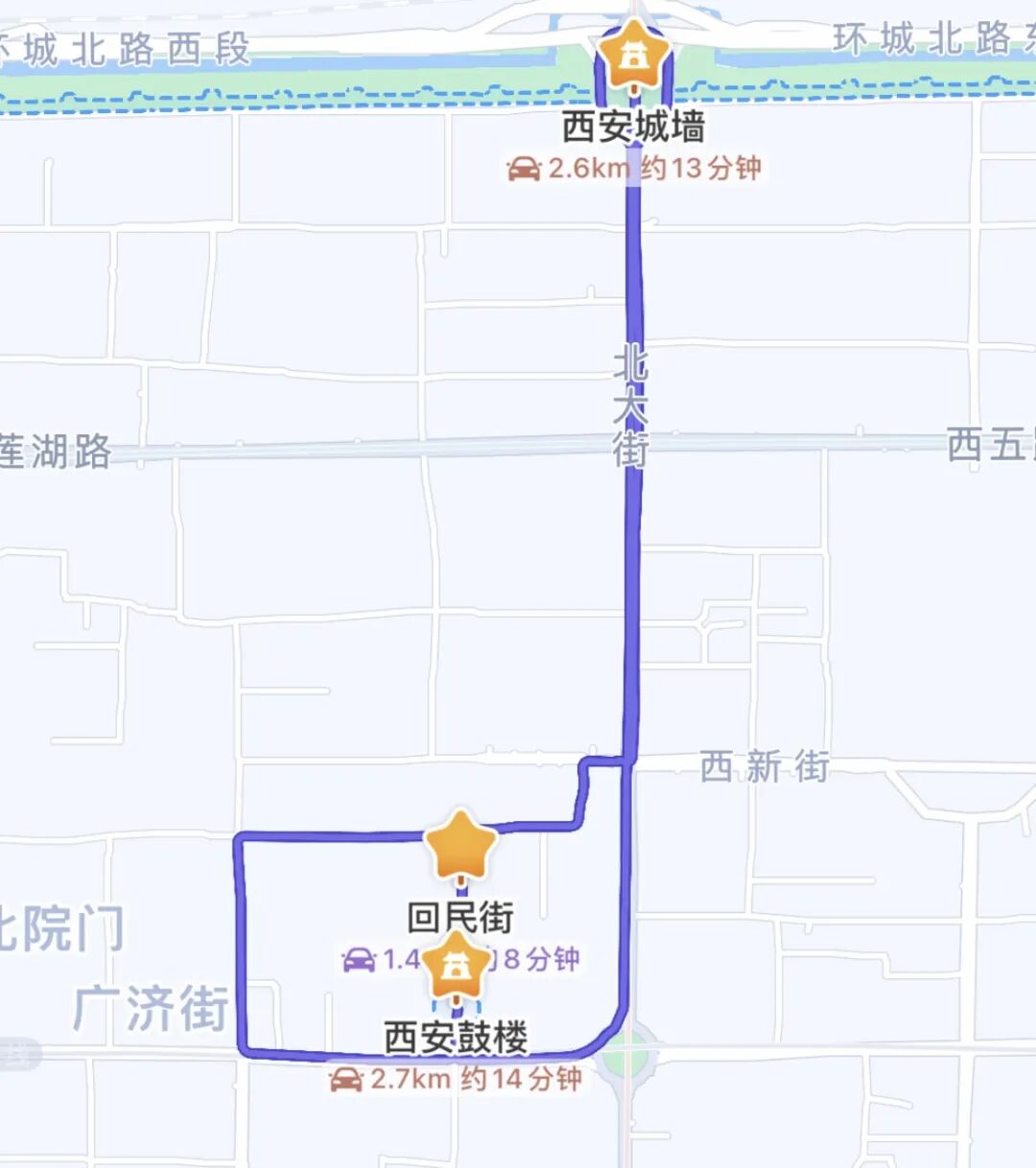
- Drum Tower (鼓楼) – Begin your Xi’an adventure at the iconic Drum Tower.
- Muslim Quarter (回民街) – Immerse yourself in the vibrant atmosphere and delicious street food of the Muslim Quarter.
- Xi’an City Wall (西安城墙) – Conclude the day with a walk or bike ride along the impressive Xi’an City Wall.
Day 2: Exploring Xi’an’s Cultural Heart
Today’s itinerary focuses on experiencing the vibrant culture and historical significance of Xi’an.
-
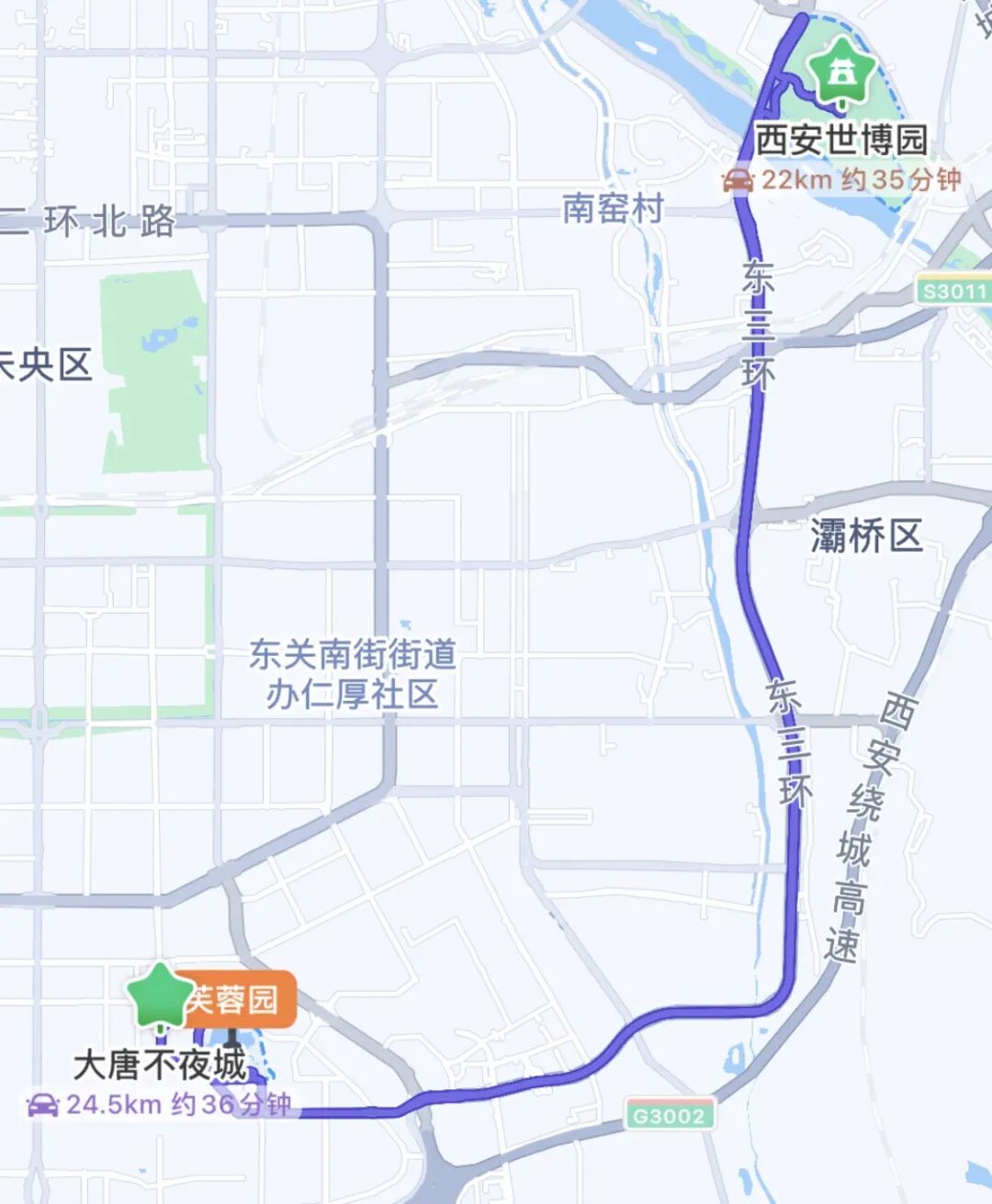
Da Tang Bu Ye Cheng (大唐不夜城): We’re starting the day at the magnificent Da Tang Bu Ye Cheng (唐不夜城), a beautifully recreated Tang Dynasty streetscape with stunning lights, performances, and traditional architecture. Prepare to be transported back in time!
-
Fu Rong Yuan (芙蓉园): Next, we’ll journey to Fu Rong Yuan (芙蓉园), a meticulously designed classical garden showcasing the elegance and artistry of the Tang Dynasty. Enjoy the tranquil atmosphere and picturesque landscapes.
-
Xi’an World Expo Park (西安世博园): Finally, we’re heading to Xi’an World Expo Park (西安世博园), the former site of the 2010 World Expo. Explore the various themed pavilions, marvel at the architectural wonders, and enjoy panoramic views of the city.
Day 3: Small Wild Goose Pagoda – Great Wild Goose Pagoda (小雁塔-大雁塔)
A day exploring the iconic Wild Goose Pagodas. Starting with the Small Wild Goose Pagoda (小雁塔), we’ll then proceed to the Great Wild Goose Pagoda (大雁塔).
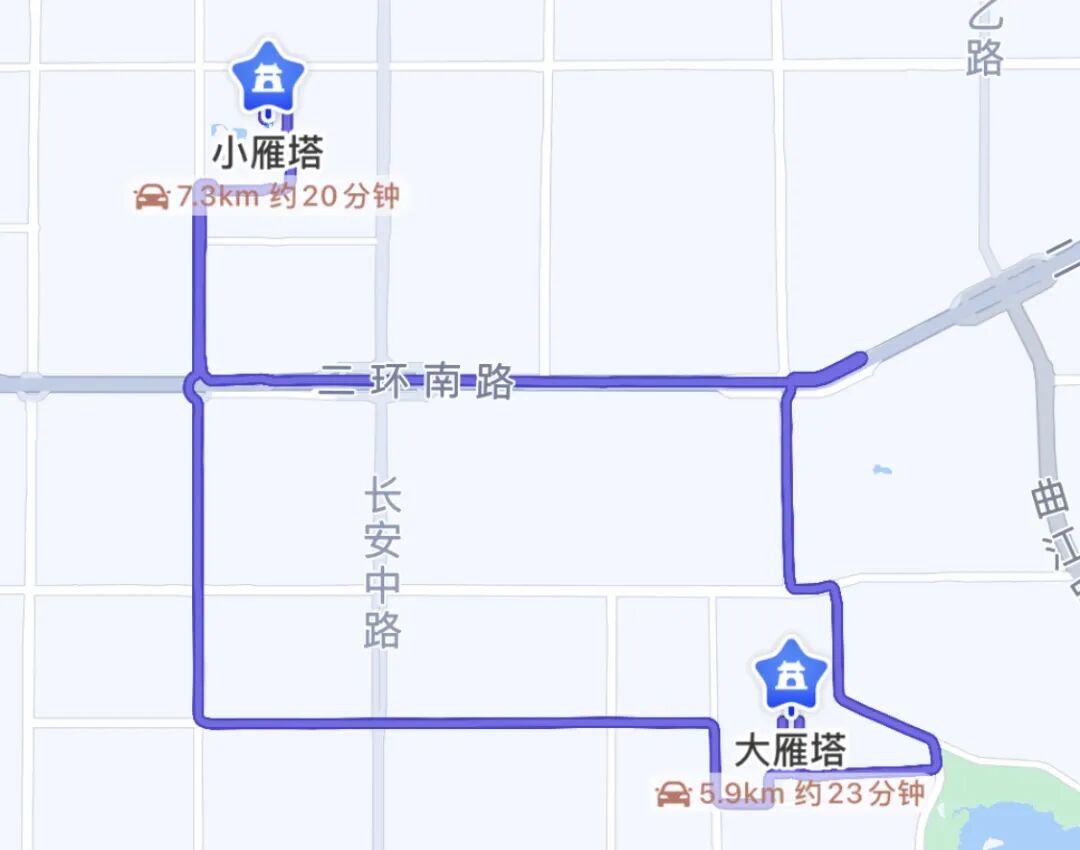
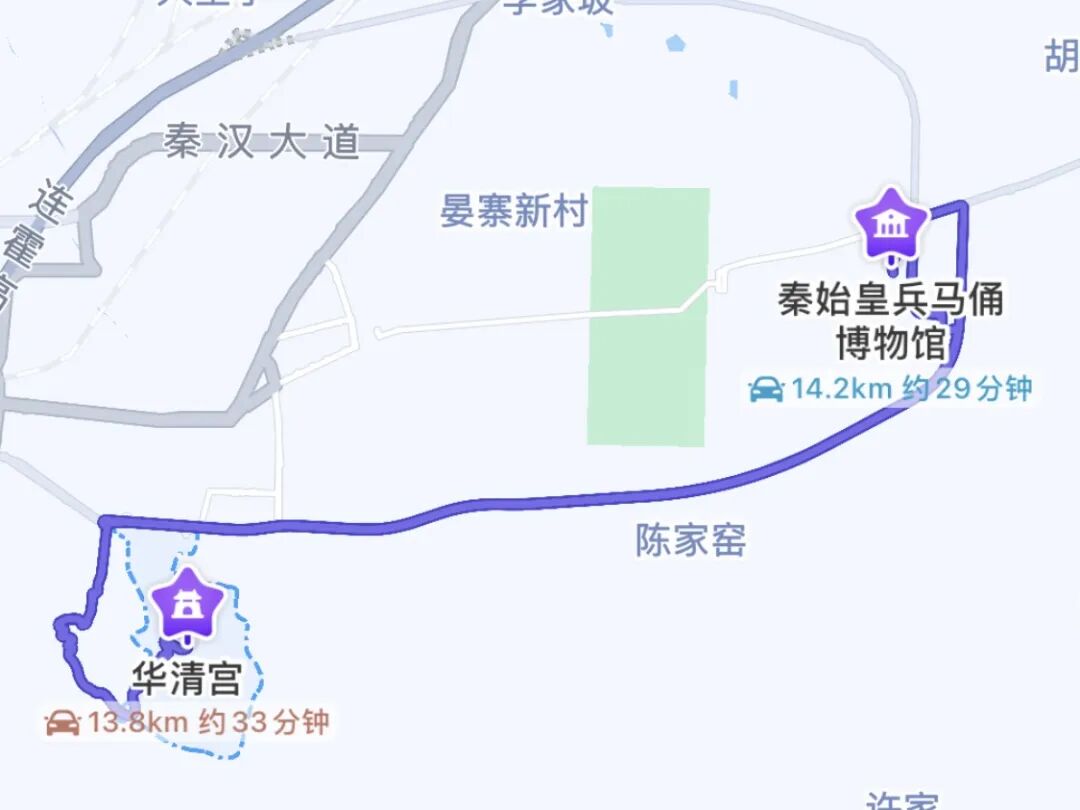
Day 4: Huaqing Palace – Terracotta Army (秦始皇兵马俑)
Today’s itinerary includes a visit to both Huaqing Palace (华清宫) and the Terracotta Army (秦始皇兵马俑). Enjoy exploring these significant historical landmarks!
The Great Wild Goose Pagoda (大雁塔)
Address: South Yan Tower Road, Yan Tower District, Xi’an City
Opening Hours: 8:30 AM – 6:00 PM
Recommended Rating: ⭐⭐⭐⭐⭐
Xi’an, the origin of the Tang Dynasty’s Chang’an (长安), and the heart of Chinese civilization. Travel through time and space and be elevated at the Great Wild Goose Pagoda (大雁塔). A visit to Xi’an (西安) isn’t complete without experiencing the Great Wild Goose Pagoda (大雁塔), a testament to Tang Dynasty Buddhist culture and the source of the glory of the Tang Dynasty.
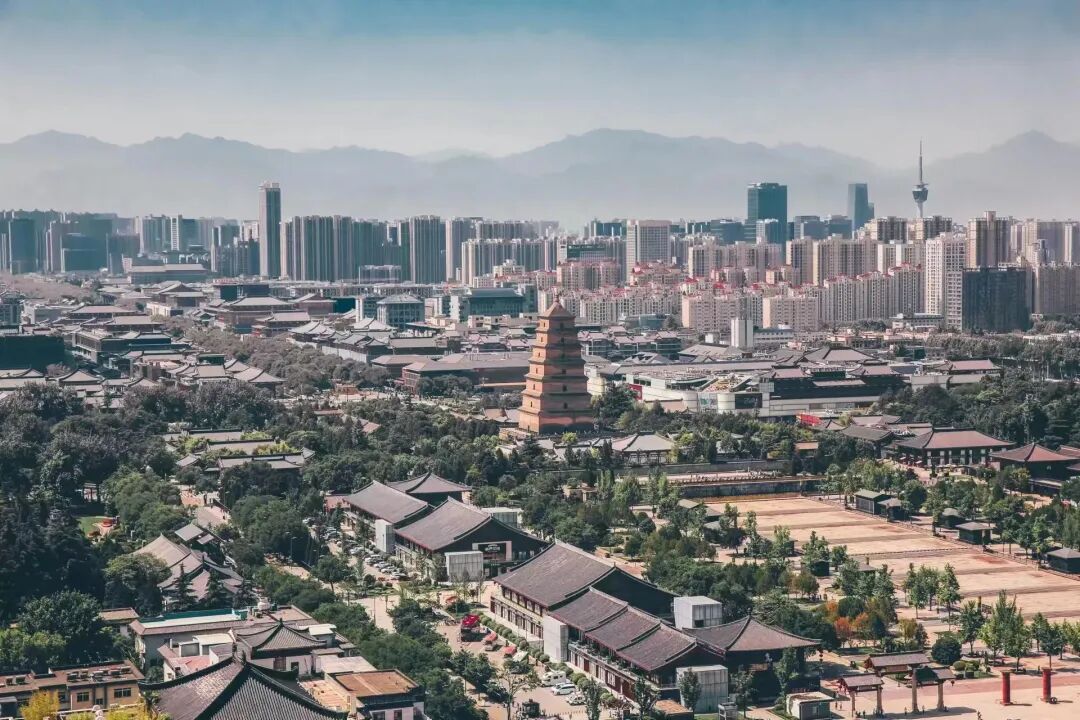

The Great Wild Goose Pagoda
The Great Wild Goose Pagoda (大雁塔), also known as the Ci’en Temple Pagoda (慈恩寺塔), Southern Treasure Pagoda (南宝塔), and Chang’an Temple Pagoda (长安寺塔), stands within the Ci’en Temple (慈恩寺) in southern Xi’an (西安). It is the oldest and largest surviving Tang Dynasty square, multi-story, brick pagoda, a symbol of the ancient capital of Xi’an (西安), and a landmark building of the city.
The Great Wild Goose Pagoda (大雁塔) resembles a phoenix in full flight, its curves graceful like those found in classical poetry. It stands as a witness to the passage of time, embodying memories and emotions along the ancient and weathered roads. Each tier of its eaves reflects the light of history.
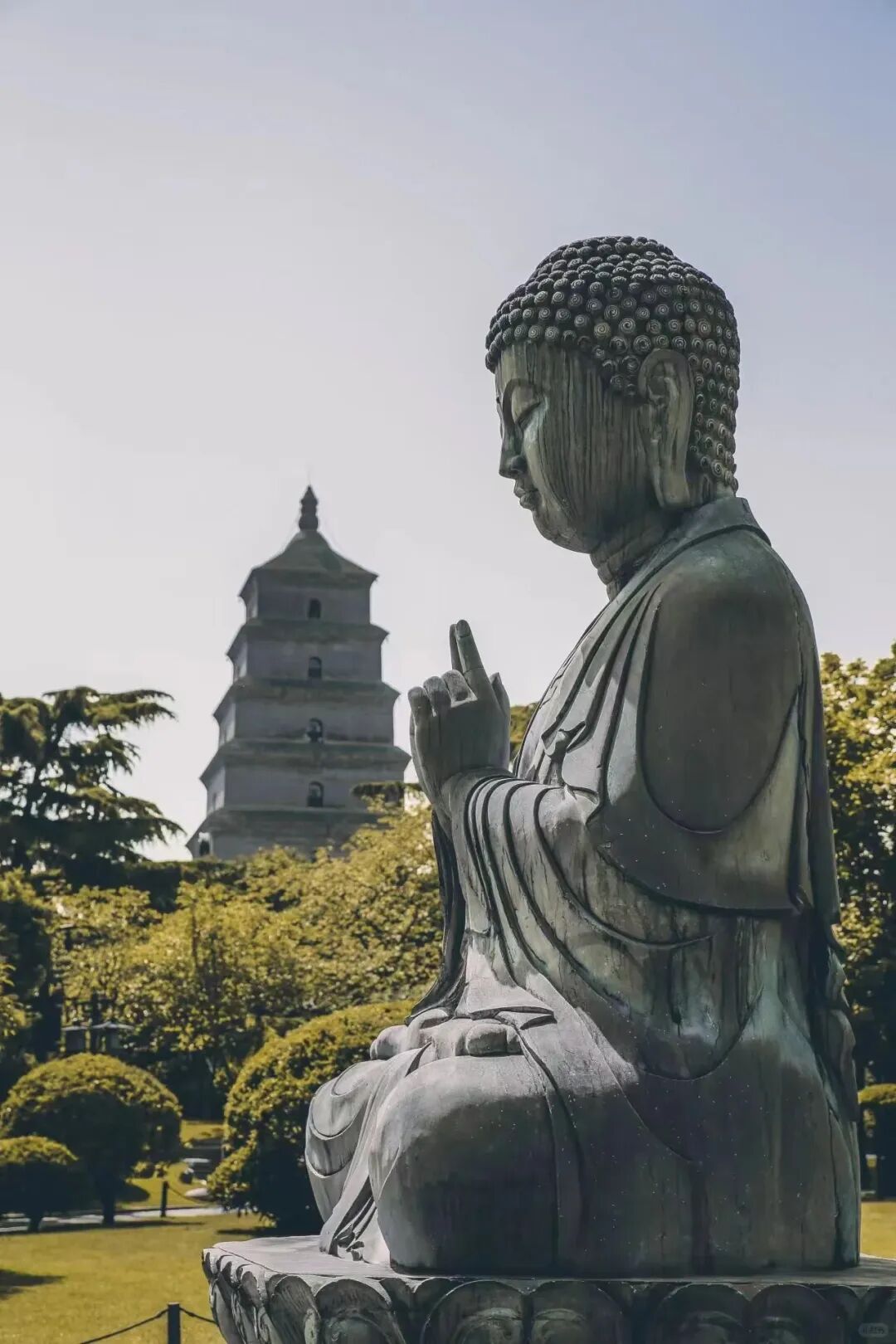
The Big Wild Goose Pagoda (大雁塔) is composed of three main parts: the base, the body, and the pagoda spire (塔刹). Initially built with five stories, it was later increased to nine. Throughout history, there were several modifications, ultimately stabilizing to the seven-story pagoda we see today. The Big Wild Goose Pagoda (大雁塔) was once a place for imperial examination candidates (进士) to inscribe their names, becoming part of the renowned “Eight Views of Guanzhong” (关中八景) – “Pagoda Inscription.” This practice led to subsequent generations associating it with success in the imperial examinations.
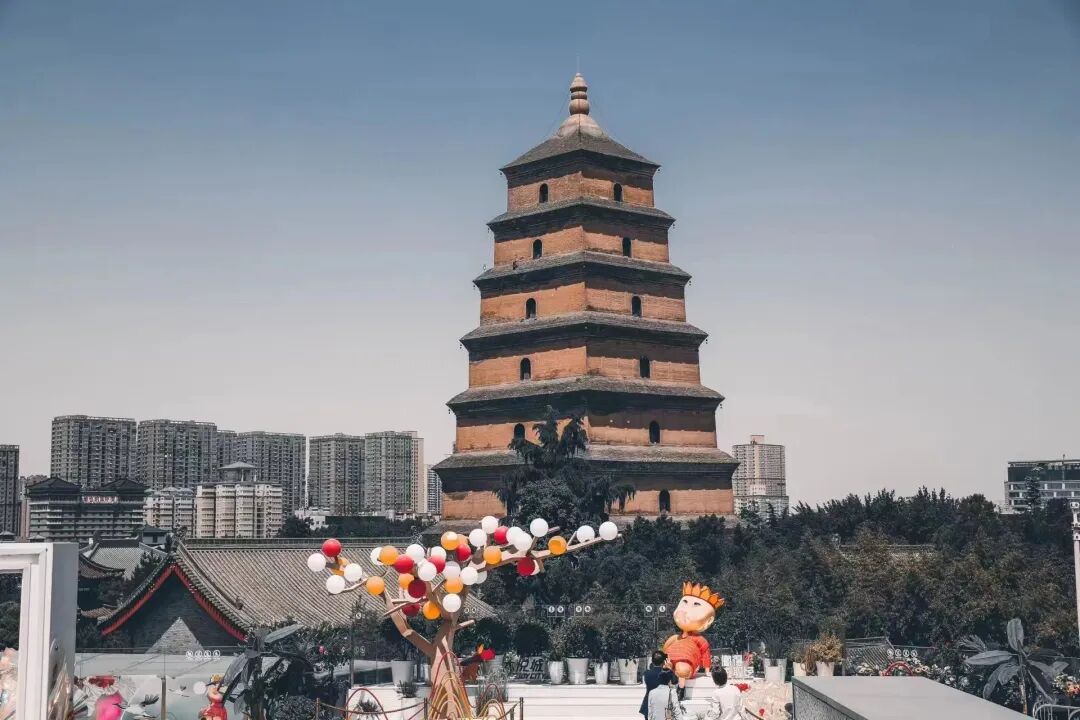
Visiting the Terracotta Army in Xi’an: A Travel Guide
🎫 Tickets:
- Adult Ticket: 40 RMB
- Student Ticket: 20 RMB (Requires ID and student ID)
- Tower Ascent Fee: Additional 20 RMB
🚗 Transportation:
- Take Subway Line 3 to (Dàyàn Tǎ) Big Wild Goose Pagoda Station.
✅ Important Note:
- Since Hanfu (traditional Chinese clothing) became popular in Xi’an, initially, the basic photography services were provided by local professional photographers, with prices starting from 399 RMB. Now, there are many photographers, so be cautious and verify their credentials.
02/ Qin Shi Huang’s Terracotta Army
-
Address: Qinling Town, Lintong District, Xi’an City
-
Opening Hours:
- 8:30 AM – 4:30 PM (November 16th – March 15th) – Off-Season
- 8:30 AM – 5:00 PM (March 16th – November 15th) – Peak Season
-
Recommended Rating: 🌟🌟🌟🌟🌟
One of the Seven Wonders of the World, the discovery of the Terracotta Army has been hailed as the Eighth Wonder of the World. Just as visiting the Eiffel Tower is essential for a true experience of France, experiencing the Terracotta Army is essential for a true experience of China.
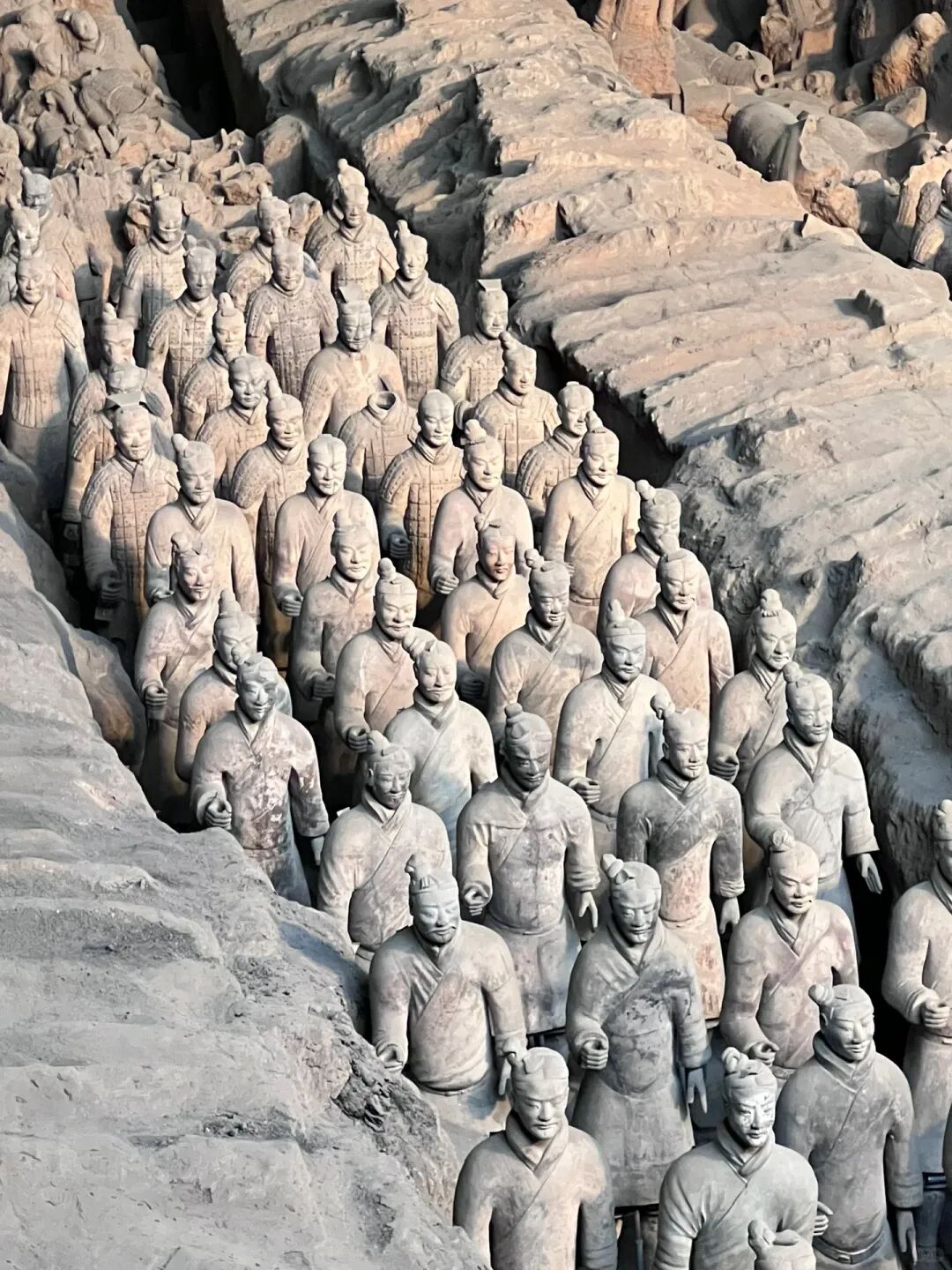
Here’s a natural and flowing English translation of the provided text, adhering to your specified rules and formatted with Markdown:
They once wore magnificent robes and rode splendid horses, yet they “lived” in the underworld, swallowed by darkness for over 2200 years. It wasn’t until the “ray of light” in 1974 that they were illuminated, astonishing the world.
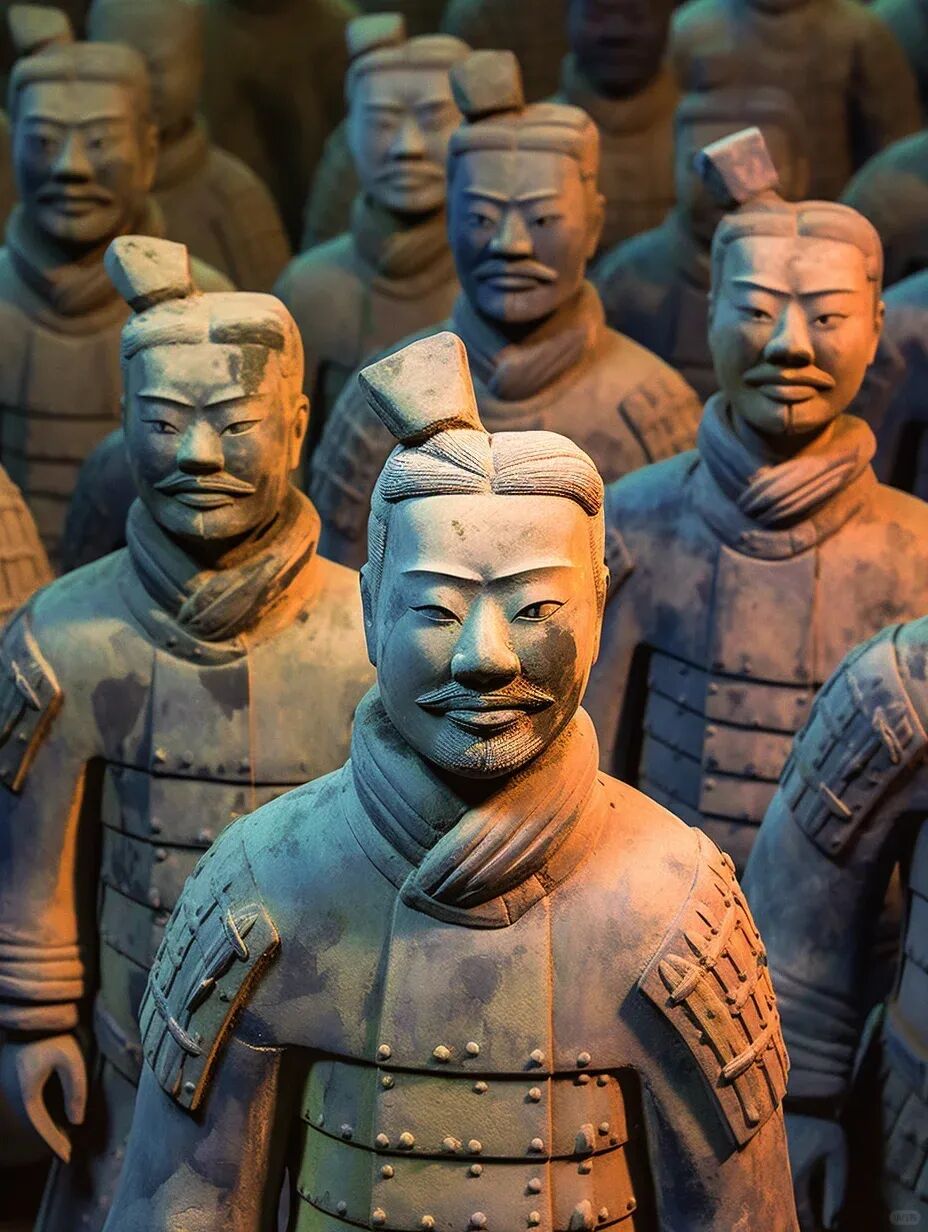
The creation of the Terracotta Army (兵马俑) was primarily based on real-life figures, employing a detailed and vibrant artistic style. Each terracotta warrior (陶俑) possesses unique attire, expressions, and postures. The hairstyles alone showcase a wide variety, as do the gestures, and facial expressions vary considerably. Their clothing, demeanor, and gestures allow for identification of their rank – whether official or soldier, infantry or cavalry. Overall, the faces of all the Qin soldiers (秦俑) convey the distinctive bearing and composure characteristic of the Qin people, demonstrating vivid individuality and a strong sense of the era.
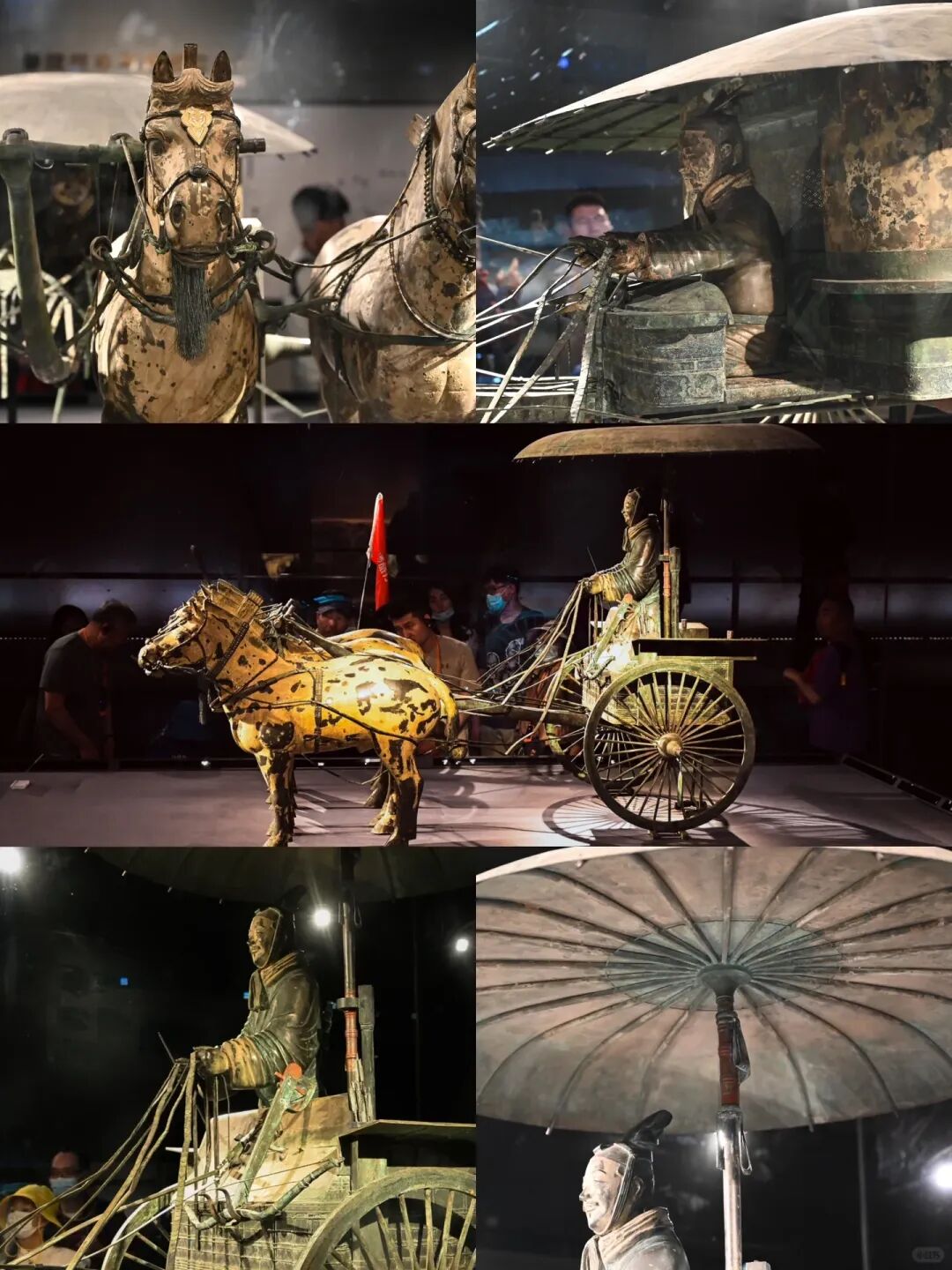
Here’s a natural and fluent English translation of your itinerary, following your rules:
Suggested Itinerary:
Our visit will begin by entering the scenic area through the North Gate (北二门) → then proceed to Pit 1 → followed by Pit 3 → then Pit 2 → and finally, we’re scheduled to visit the Exhibition Hall (文物陈列厅) before concluding our visit.
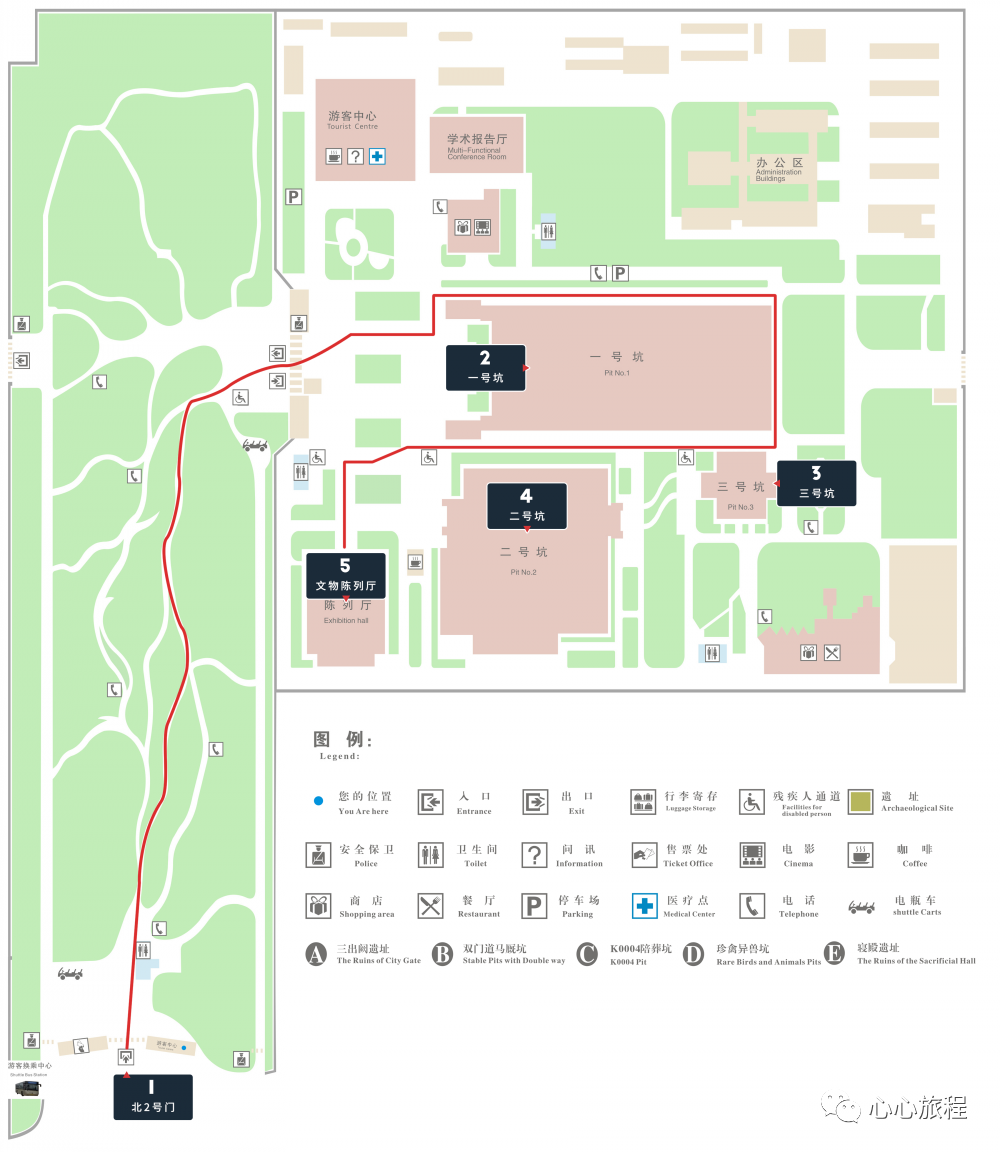
🎫 Tickets: Adult ticket 120 RMB/person; Student ticket 60 RMB/person
🚗 Transportation: Take buses/subway to the East Square of the Xi’an Railway Station and transfer to Route 306 (Yóu 5), Route 914, or Route 915. We recommend Route 306 (Yóu 5) or Route 915, as these routes use expressways and are faster. All three routes require passengers to pay directly on board; no round-trip tickets are sold. Be aware of fake taxis that may attempt to sell round-trip tickets.
✅ Note: Upon entering the scenic area’s main entrance, you may choose to take an electric sightseeing cart (10 RMB/person, approximately 5 minutes) if desired. Walking takes about 15 minutes.
03/ Datang Furong Garden (大唐芙蓉园)
Address: Qujiang New District, Xi’an City
Opening Hours: 9:00 AM – 9:00 PM (20:30 PM garden closure)
Recommended Rating: 🌟🌟🌟🌟🌟
In the hearts of many, Datang is Chang’an (长安), Chang’an is Datang, and Datang Furong Garden (大唐芙蓉园) represents today’s Chang’an.
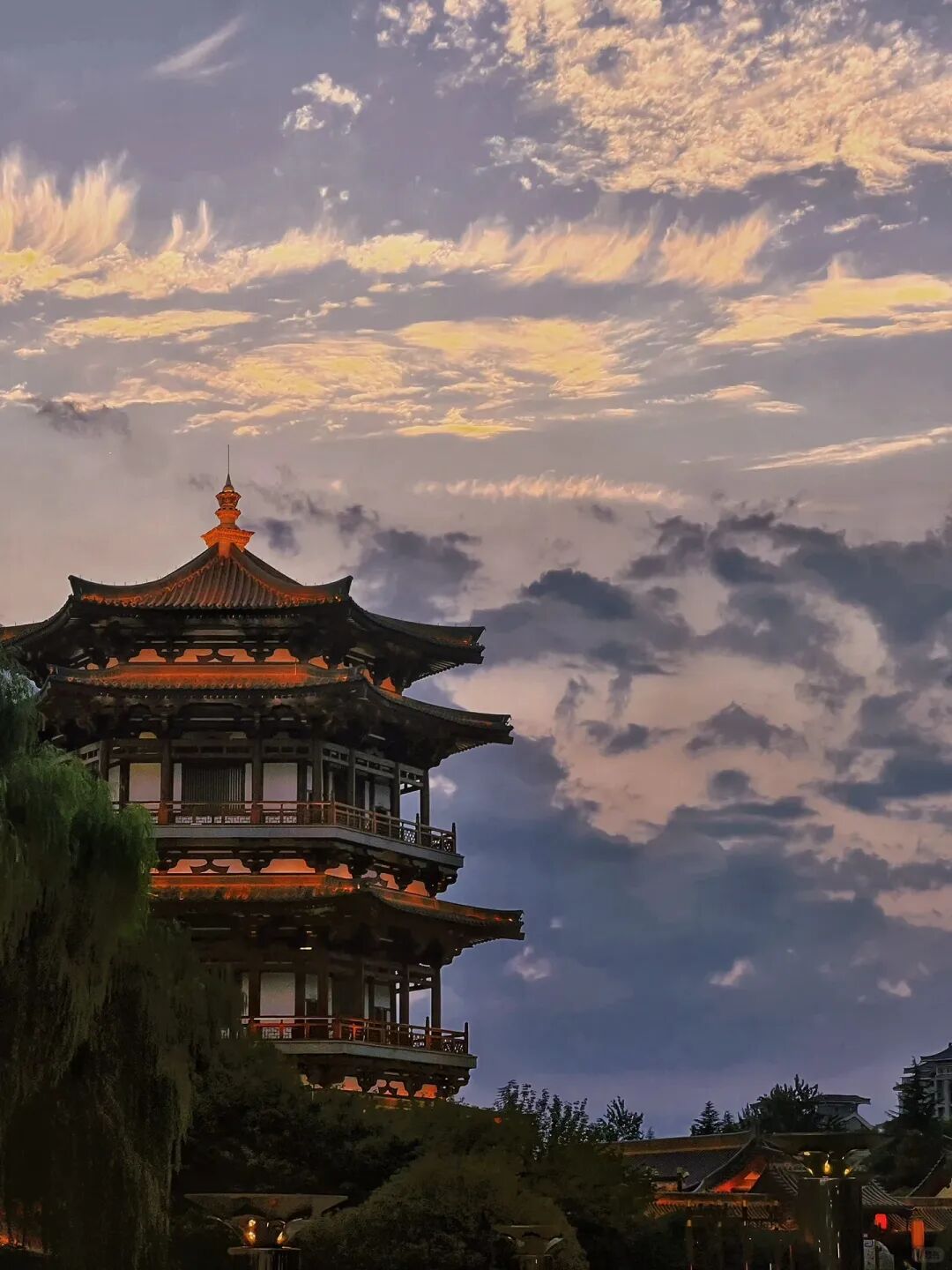
The mid-Tang Dynasty (盛唐时期), was one of the most glorious periods in Chinese history. Emperor Taizong (唐太宗李世民) of the Tang Dynasty ushered in a new era of politics, culture, and economics, making the Tang Dynasty a prosperous and powerful nation. The Grand Tang Dynasty Floral Garden (大唐芙蓉园), is a large-scale themed park designed to recreate the architecture, culture, and arts of the Tang Dynasty era.
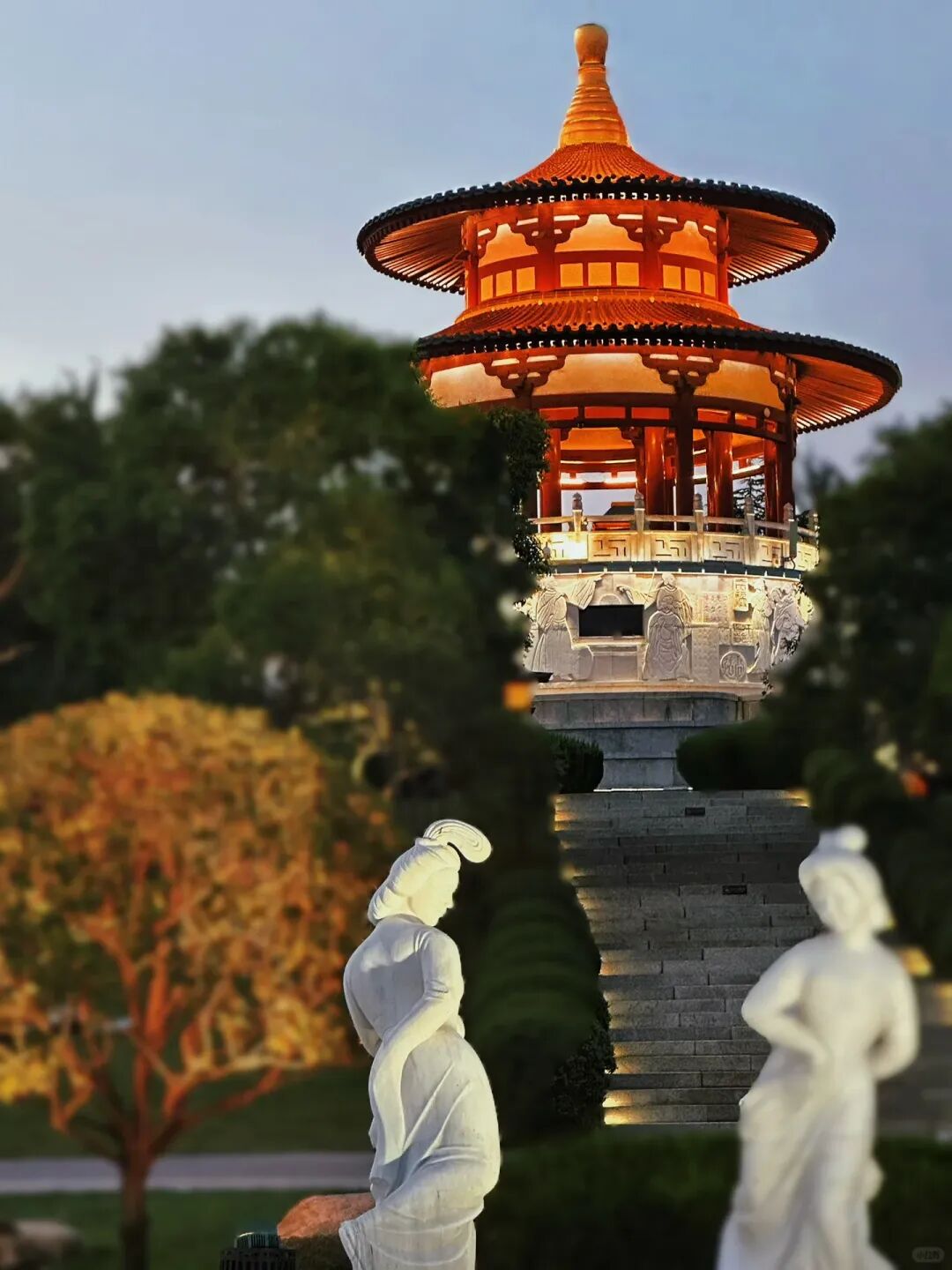
Description of Ziyun Tower
Ziyun Tower (紫云楼) is a landmark building of the (Da Tang Fu Rong Yuan) (大唐芙蓉园), and one of the “New Chang’an Three Famous Towers.” It is also the largest and most representative traditional architectural structure within the entire garden.
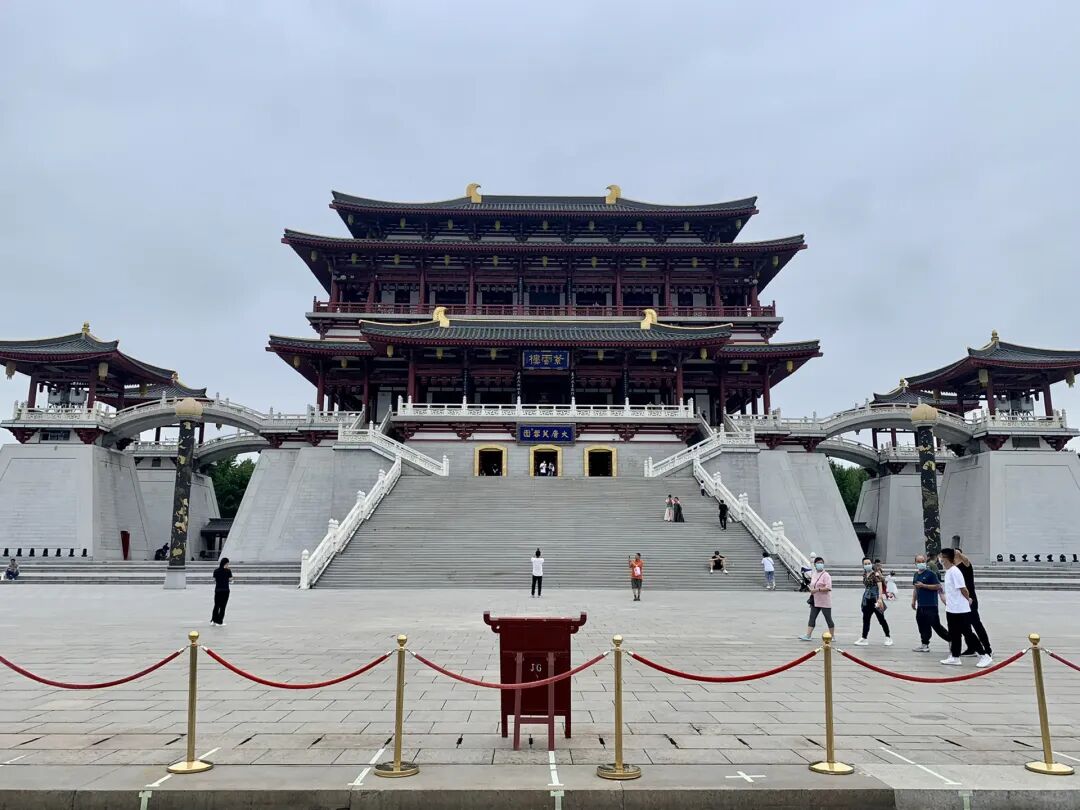
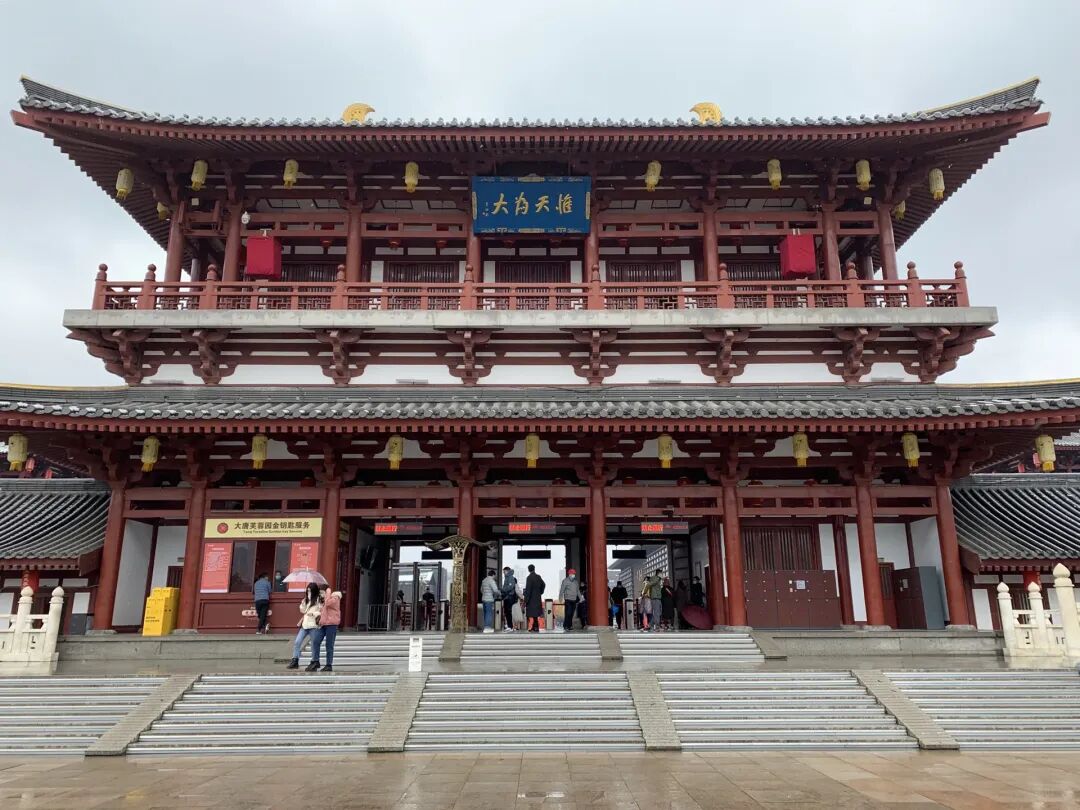
The Gate of the Imperial Garden (御苑门)
The Gate of the Imperial Garden (御苑门) is the western entrance to the Tang Dynasty Paradise (大唐芙蓉园), named to signify a royal visit to a secluded imperial garden. It employs a design of one main gate flanked by two subordinate gates and three gateways (三出阙), featuring a magnificent, two-story main gatehouse and adjacent gateways that complement each other, creating a grand and imposing atmosphere.
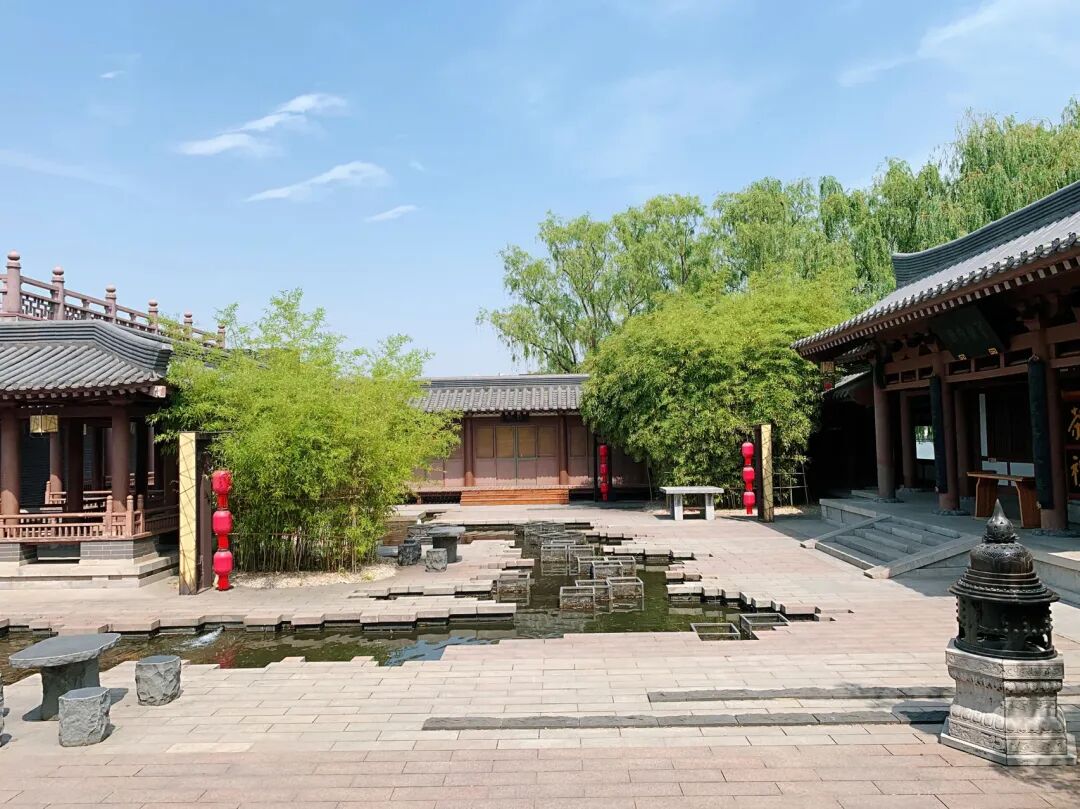
Lu Yu Tea House: A Tranquil Retreat
Lu Yu Tea House, named after the revered tea master (陆羽), adopts a traditional Chinese courtyard architectural style featuring a house, a pavilion, a corridor, and a hall seamlessly connected, and stone, bamboo, flowers, and water harmoniously integrated.
The tea house combines tea ceremony performances with leisurely tea appreciation, with each architectural unit thoughtfully arranged within an open water courtyard. Curving corridors and arched bridges artfully connect the various spaces.
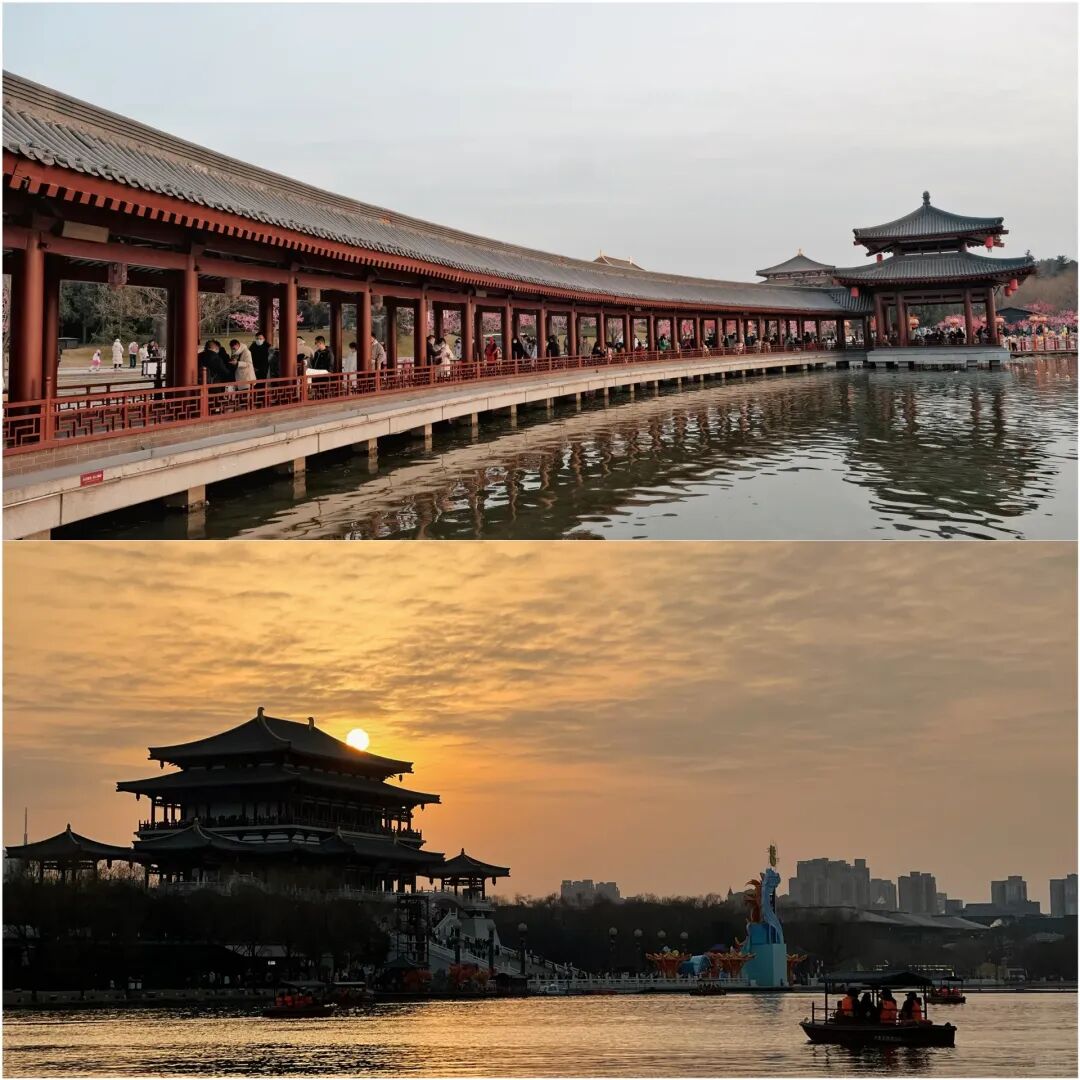
彩霞长廊 (Cǎixiá Chángláng) is a significant building within the (Fúróng Yuán) Imperial Garden of the Tang Dynasty. Originally constructed during the flourishing Tang era, it gained prominence alongside the (Zǐyún Lóu) Purple Cloud Tower when Emperor Wen Zong rebuilt the garden. The (Cǎixiá Chángláng) comprises the Golden Pavilion, the Jade Pavilion, and a long corridor, spanning a total length of 270 meters. It serves as a cultural corridor reflecting the multifaceted lives of Tang Dynasty women, and is an ideal location for appreciating the scenic beauty of (Fúróng Hú) Fúróng Lake and viewing the Great Wild Goose Pagoda in the distance.
Tickets:
① Peak Season: 120 Yuan, Student Ticket: 60 Yuan; Off-Season: 90 Yuan (Includes scenic area entrance ticket, water curtain movie, and various performances, excluding the “Dream Back to the Tang Dynasty” program).
② Package Ticket: 140 Yuan (Includes scenic area entrance ticket, water curtain movie, “Dream Back to the Tang Dynasty” dance performance, and various performances).
Transportation:
① Bus Routes: Take buses 21, 22, 24, 41, 212, 224, 237, 320 (Tour 9), 601, 609, 610, 715, 720 to reach the destination. (You can take bus K5 from the Railway Station to the Big Wild Goose Pagoda (大雁塔) and then take one of the above buses).
② Driving Route: From the Bell Tower (钟楼) in Xi’an City, follow Dongdajie Street – Heping Road – Yanta North Road – Cien West Road to the destination, approximately 10 kilometers, taking about 30 minutes.
✅ Note: There are West Gate Station and South Gate Station for the Datong Furong Garden. The Datong Furong Garden currently opens North Gate (Chunming Gate), West Gate (Yuanmen Gate), and Tang City Exit. The West Gate is the main entrance, and most tourists enter through this gate.
04/ Xi’an City Wall (西安城墙)
Address: Xi’an City Wall Scenic Area
Opening Hours: 08:00 – 22:00
Recommended Rating: 🌟🌟🌟🌟🌟
To understand Xi’an, in addition to the must-see Terracotta Army, another essential thing to do is to climb the Xi’an City Wall. Just as it’s said that you’re not a real person until you’ve been to the Great Wall, it’s also quite a regret if you don’t go up the City Wall.
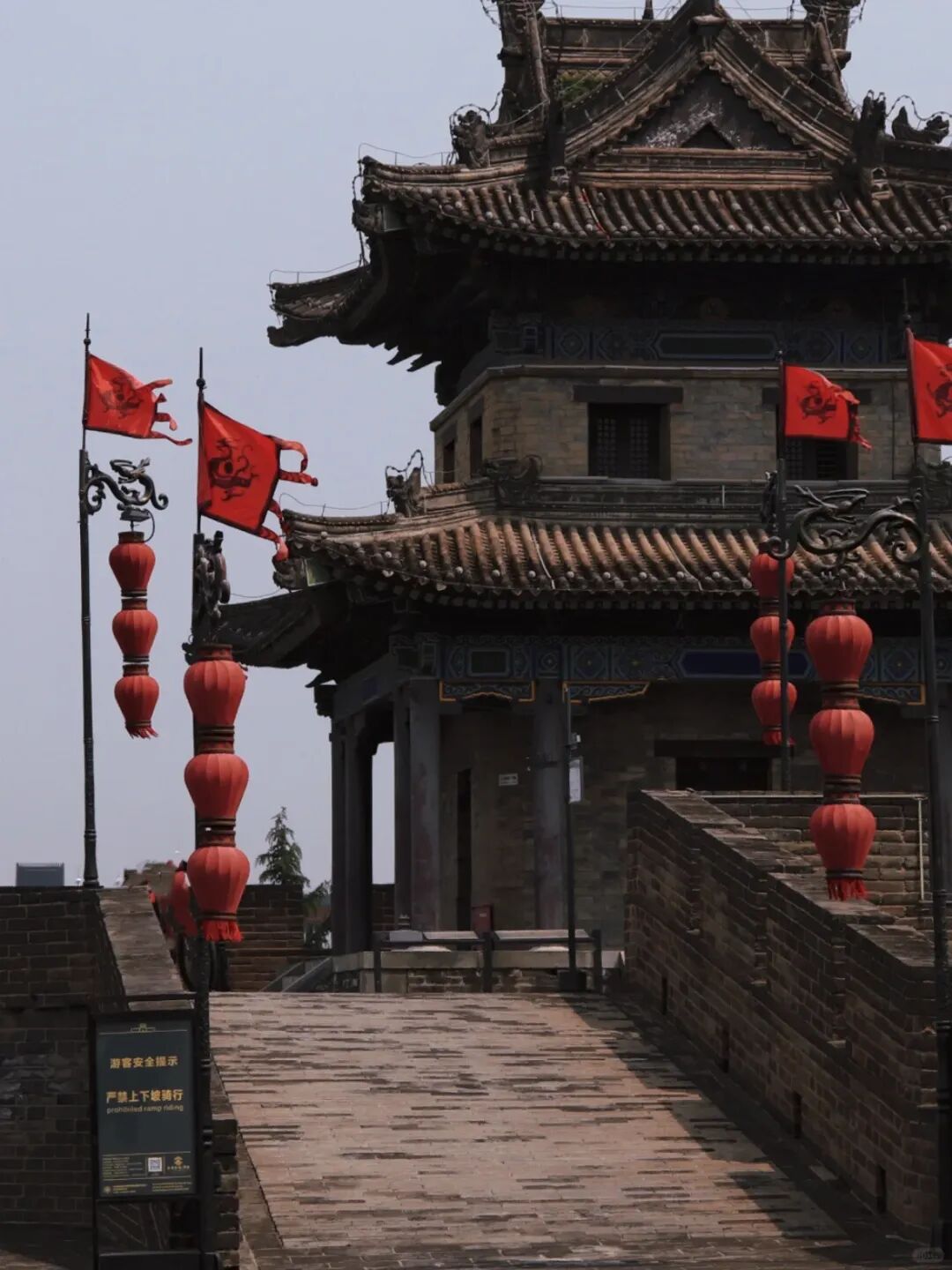
The Xi’an City Wall (西安城墙), located in the central area of Xi’an, encompasses both the Tang City Wall (唐城墙) and the Ming City Wall (明城墙) in Xi’an, but typically refers to the narrow sense of the Ming City Wall (明城墙). Construction began during the Hongwu period of the Ming Dynasty, and it is currently the largest and best-preserved ancient city wall in China. Local residents commonly refer to the area within the city wall as the Ancient City (古城区), with the famous Xi’an Bell Tower and Drum Tower (西安钟鼓楼) situated in the very heart of the Ancient City.
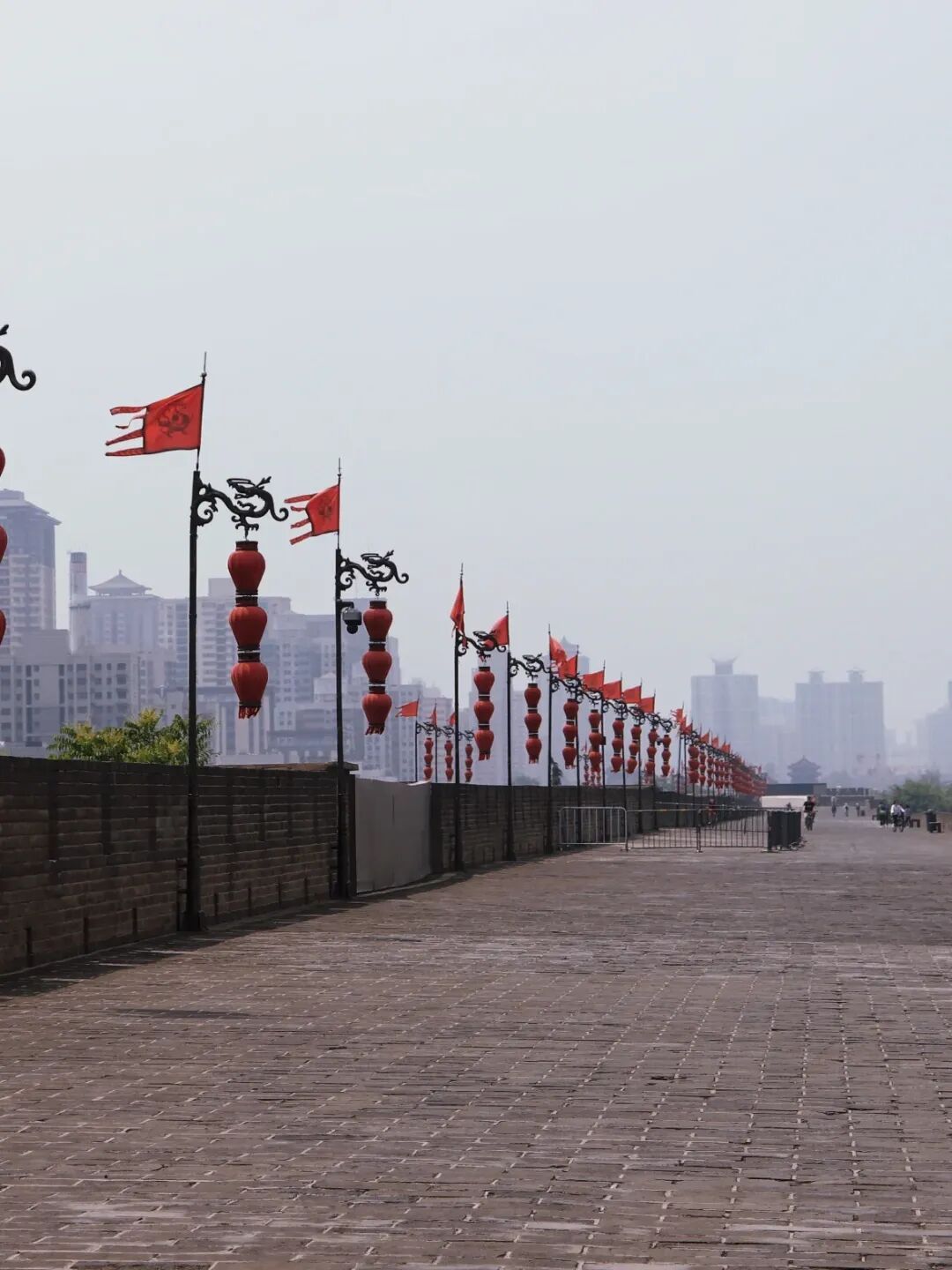
The city wall features four original main gates: the East Gate (Chang Le Men), the South Gate (Yong Ning Men), the West Gate (An Ding Men), and the North Gate (An Yuan Men). Since the Republic of China era, to facilitate transportation within the ancient (Jing Chu) city district, numerous new gates have been opened, bringing the total number of gates to over eighteen today.
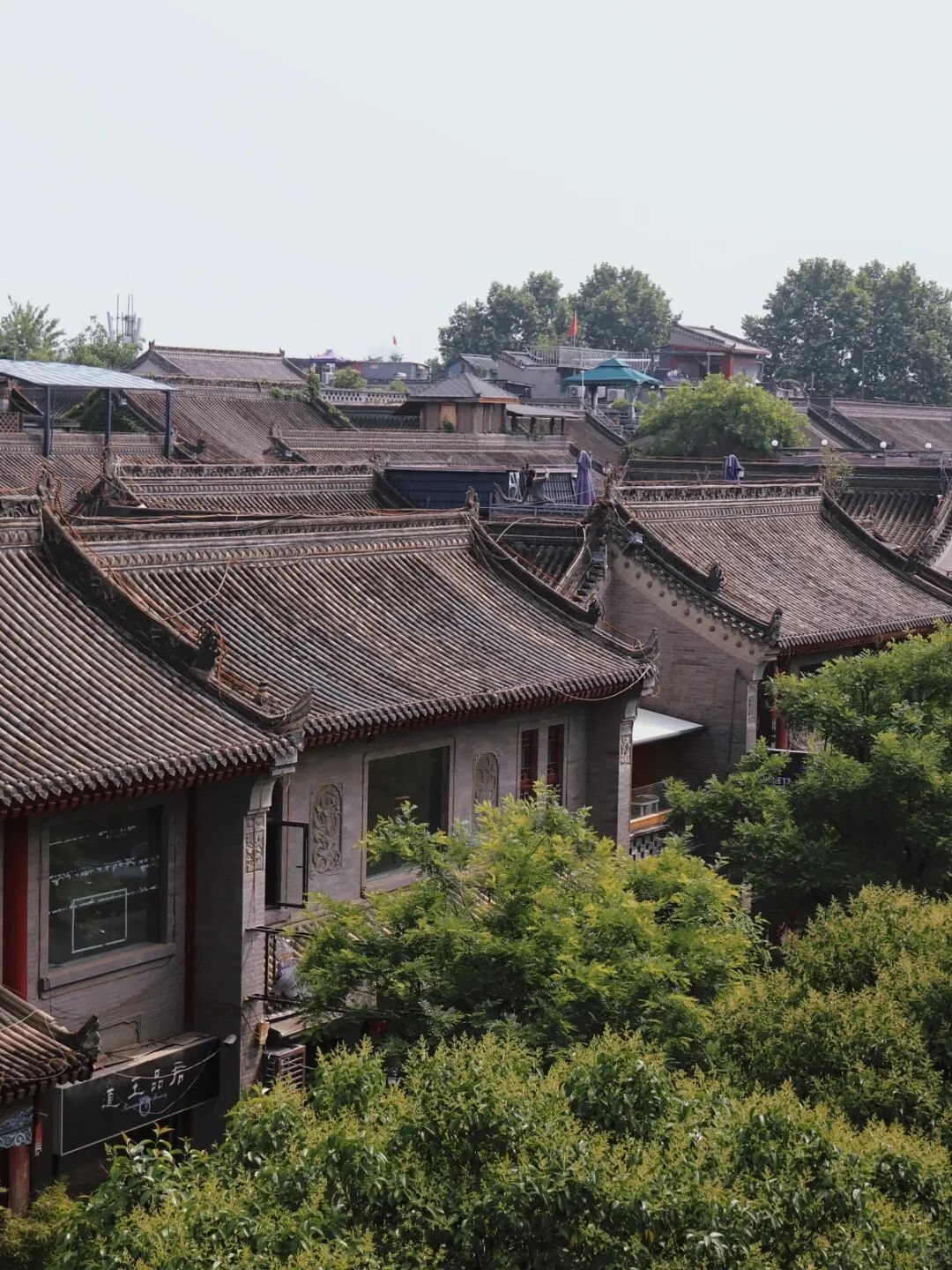
Xi’an City Wall & Tang Dynasty Night City (大唐不夜城)
🎫 Tickets: Adult Ticket: 54 RMB / Half-Price Ticket: 27 RMB (January 1st – December 31st, Monday – Sunday) Half-Price Available
🚗 Transportation: By Bus: Take buses 9/26/28/33/37/182/208/236 to North Gate (北门里) Station and walk approximately 100 meters to reach the City Wall.
✅ Important Notes:
① Food & Drink: There are no restaurants on the City Wall itself. You’ll find some stalls selling drinks and snacks, but prices are relatively high. It’s recommended to bring your own water and food. There are numerous restaurants and snack shops under the City Wall offering Xi’an’s specialties like (Roujiamo – 肉夹馍), (Yangrou Paomo – 羊肉泡馍), (Liangpi – 凉皮), and (Suantuan Guodou – 酸汤水饺).
② Photography: The City Wall provides stunning contrasts between Xi’an’s ancient history and modern cityscape. It’s also a fantastic place to capture the architecture and sculptures. The best light for photography is in the morning or evening to avoid crowds. There’s a viewing platform near the South Gate (南门) where you can photograph the entire South Gate and a distant view of the Bell Tower (钟楼).
Tang Dynasty Night City (大唐不夜城)
Address: Yan Tower South Road, Yan Tower District, Xi’an City
Opening Hours: 08:00 – 22:00
Recommended Rating: 🌟🌟🌟🌟🌟
If there’s one place that can transport you back to the Tang Dynasty, it must be the Tang Dynasty Night City! It’s the nation’s only large-scale, pedestrian street featuring a replica of Tang Dynasty architecture and themed around Tang culture. Strolling through this picturesque setting feels like stepping back in time; the atmosphere of the Tang Dynasty is truly captivating and mesmerizing!
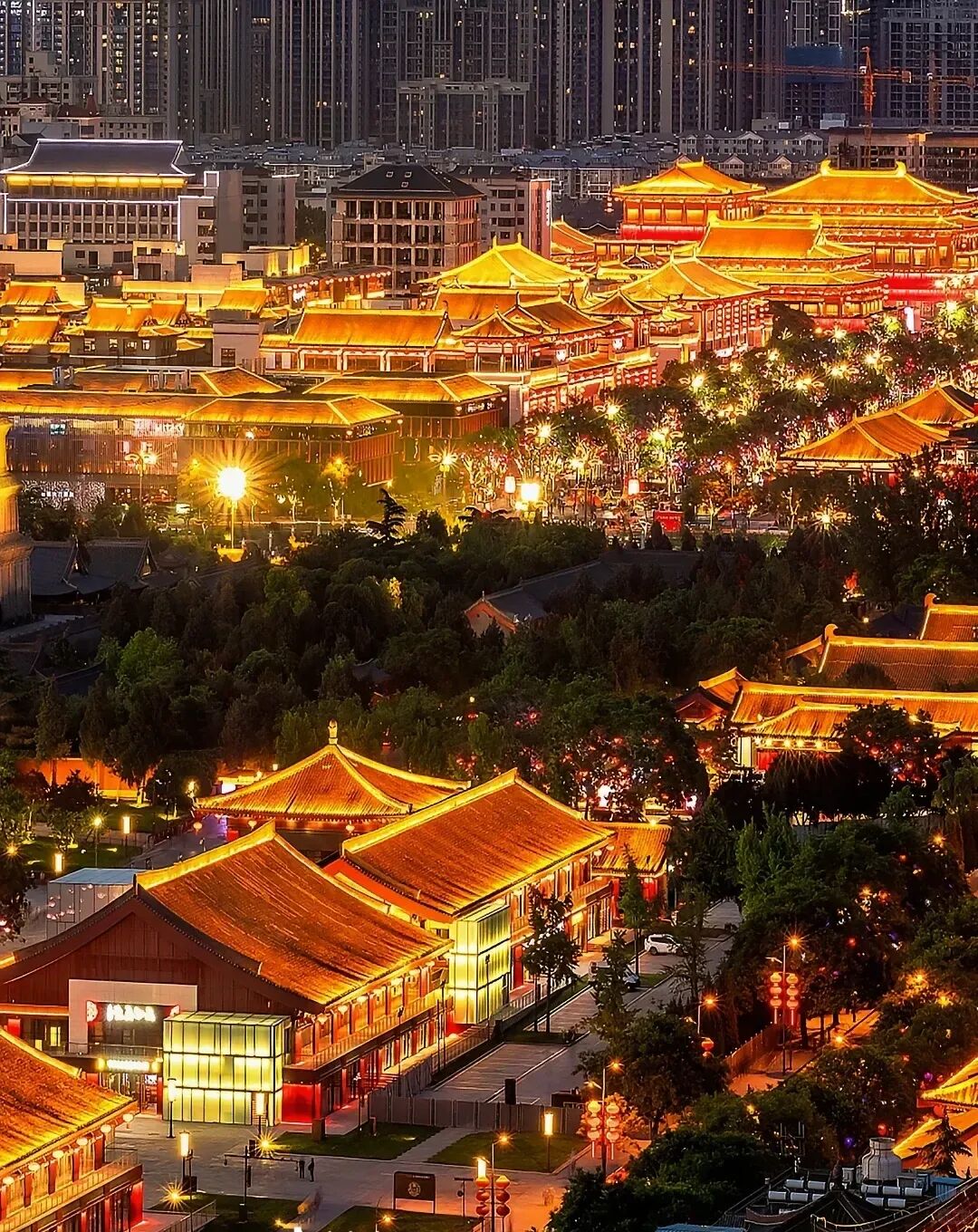
Here’s a natural and fluent English translation of the provided text, adhering to your specified rules:
The Grand Tang Dynasty Eternal Light City (大唐不夜城), extending from Ci’en East Road (慈恩东路) to the remains of the Tang City Wall (唐城墙遗址) to the south, and from Ci’en West Road (慈恩西路) to the South Square of the Great Wild Goose Pagoda (大雁塔南广场) to the north, forms a rectangular commercial district. It’s not only a thriving commercial hub but also a landmark district of Xi’an.
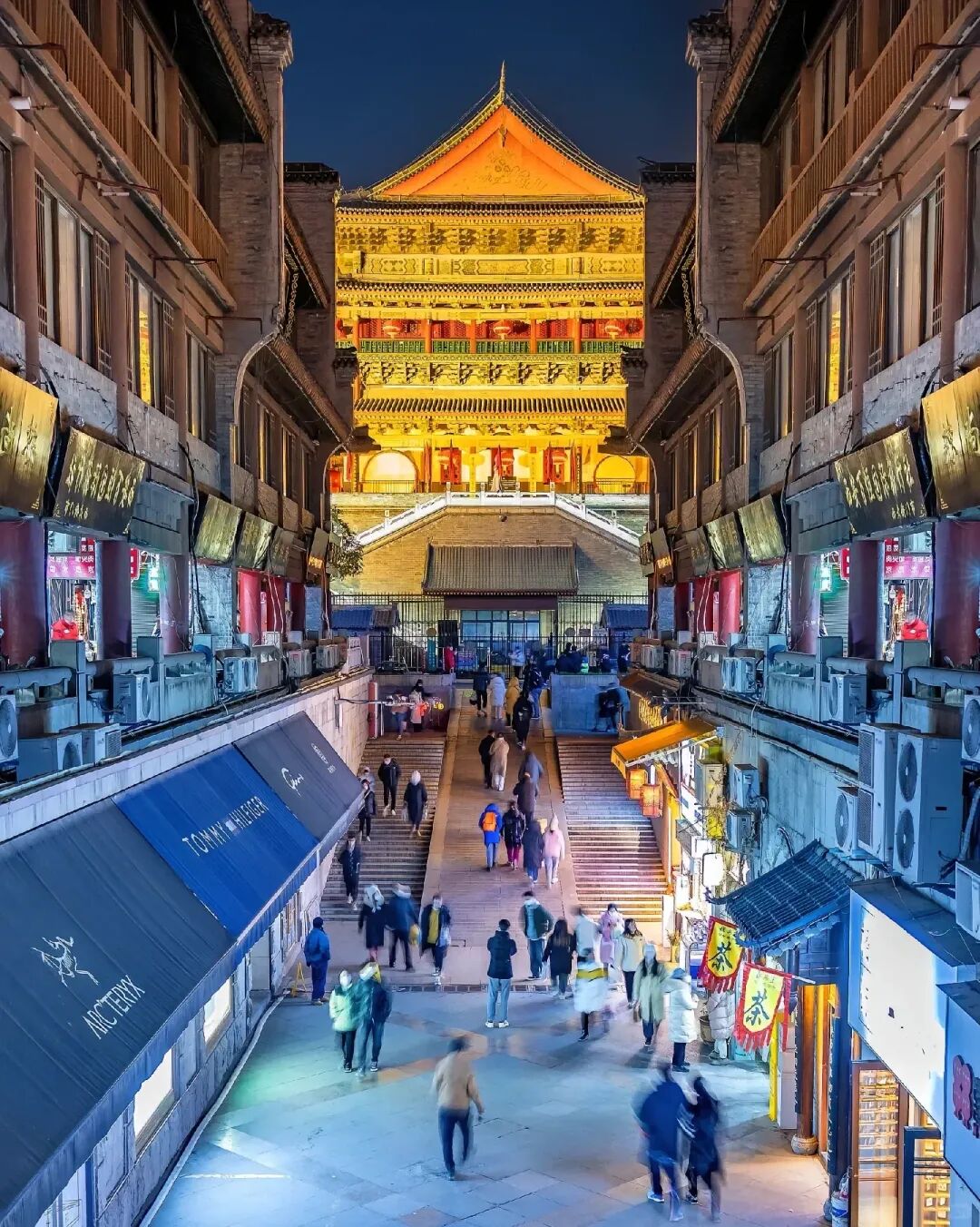
The entire complex is organized along a north-south street axis, following a layout of “one axis, two cities, three cores, four districts, and five inner streets.” It is divided into five distinct areas: a commercial pedestrian street, (Zhènguān) Zhenguan Square, a cultural exchange square, a celebration square, and a park preserving the remains of the ancient city wall (Gǔchéngqiáng Yízhǐ Gōngyuán). The complex is further defined by four groups of cultural and artistic buildings: the Xi’an Grand Theatre (Xi’ān Dàjùyuàn), the Xi’an Concert Hall (Xi’ān Yīnyuè Tīng), the Qujiang Art Museum (Qūjiāng Měishùguǎn), and the Qujiang Pacific Cinema (Qūjiāng Tàipíng Yǐngchéng).
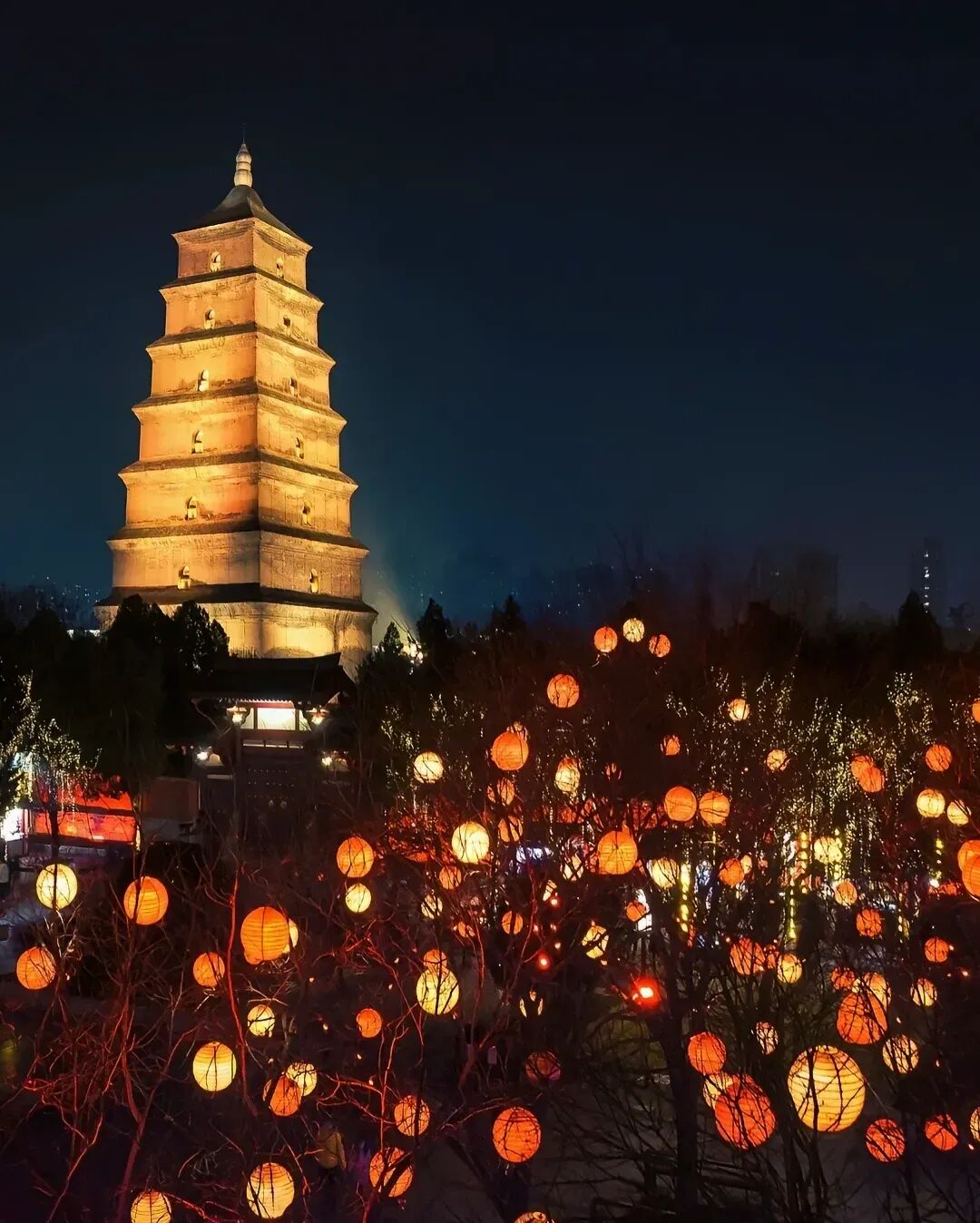
🎫 Tickets: Not required
🚗 Transportation:
① Subway: Exit from Subway Station C/B of (Dayan Tower)
② Bus: Take the Qujiang Tourist Loop Line, or buses 5, 21, 27, 30, 41, 224, 271, 401, 408, 501, 601, 606, 715, 920 (Tangyu), 920 (Jiaodai), Tour 6, Tour 8 (610), and get off at the (Dayan Tower) South Square Station.
③ Driving: Not recommended due to crowds. If you choose to drive, consider the parking lot near the west side of the (Dayan Tower) North Square, but be aware that parking fees are high.
✅ Note: Don’t arrive too early. Exit the (Dayan Tower) subway station heading south around 18:30, and explore from north to south. Remember to check the latest version of the performance schedule in advance!
06/ (Xiaoyan Tower)
Address: No. 72, Friendship West Road, Beilin District, Xi’an City
Opening Hours: 08:00-22:00
Recommended Index: 🌟🌟🌟🌟🌟
Xi’an boasts both the (Dayan Tower) and the (Xiaoyan Tower), separated by just one character. The (Xiaoyan Tower) is one of the ancient city’s landmarks and one of the oldest Buddhist pagodas in China, a must-see attraction for visitors to Xi’an.

The Small Wild Goose Pagoda (小雁塔), also known as the Jinfu Temple Pagoda (荐福寺塔), is located within the Xi’an Museum (西安博物院). It is a masterpiece of Buddhist architecture from the Tang Dynasty, representing a fine legacy of Tang Dynasty Buddhist architectural art. Together with the Bell Tower’s ancient bell, it forms the renowned “Wild Goose Pagoda Morning Bell” and is celebrated as one of the “Eight Views of Guanzhong.”

武则天 (Wu Zetian) is said to have built the Xianfu Si (献福寺) temple to commemorate her deceased husband, Emperor Gaozong Li Zhi. Later, she renamed the temple Jianfu Si (荐福寺). Subsequently, Emperor Zhongzong Li Xian expanded the temple and constructed a new pagoda, which he named “Jianfu Si Pagoda” (荐福寺佛塔). As time passed, the Jianfu Si temple vanished, but the pagoda fortunately survived, and it is now known as the “Little Wild Goose Pagoda” (小雁塔).
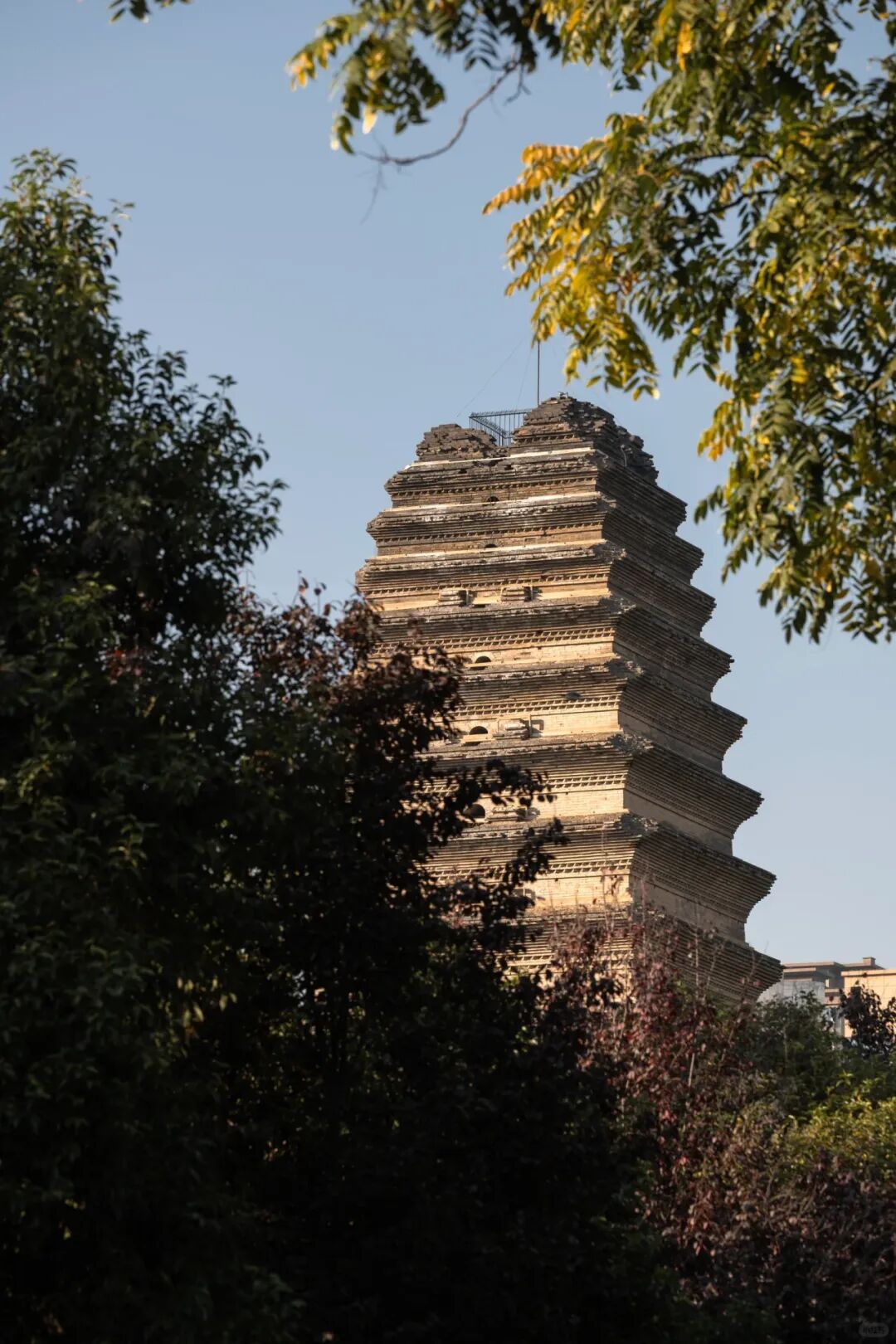
🎫 Tickets: Free
🚗 Transportation:
① Subway: Take Subway Line 2 or Line 2 to (Nán Shāo Mén) Station, Exit A, and walk west for approximately 900 meters.
② Bus: Take buses 203, 21, 224, 258, 40, 410, 46, 521 to (Xiǎo Yàn Tǎ) Station, or buses 18, 203, 204, 218, 229, 258, 407, 410 to (Xià Jiā Zhuāng) Station.
✅ Note:
① When taking photos at (Xiǎo Yàn Tǎ), don’t just focus on the pagoda. There are many other wonderful scenes to capture. The park boasts many ancient trees; incorporating people into your photos, either as subjects or in the foreground, adds a beautiful and artistic touch.
🕰️ Drum and Bell Towers (Zhōng Gǔ Lóu)
Address: City Center, (Zhōng Gǔ Lóu), Xi’an
Opening Hours: 8:30 AM – 18:00 PM (Entry stops at 17:30)
Recommended Rating: 🌟🌟🌟🌟🌟
The Bell Tower was originally built in the 17th year of Hongwu during the Ming Dynasty. It’s named the Bell Tower because of the large bell hanging inside, used to signal the time. As the largest, most complete, and oldest surviving bell tower in China, it quietly stands in the city center, witnessing the development of Xi’an over centuries.
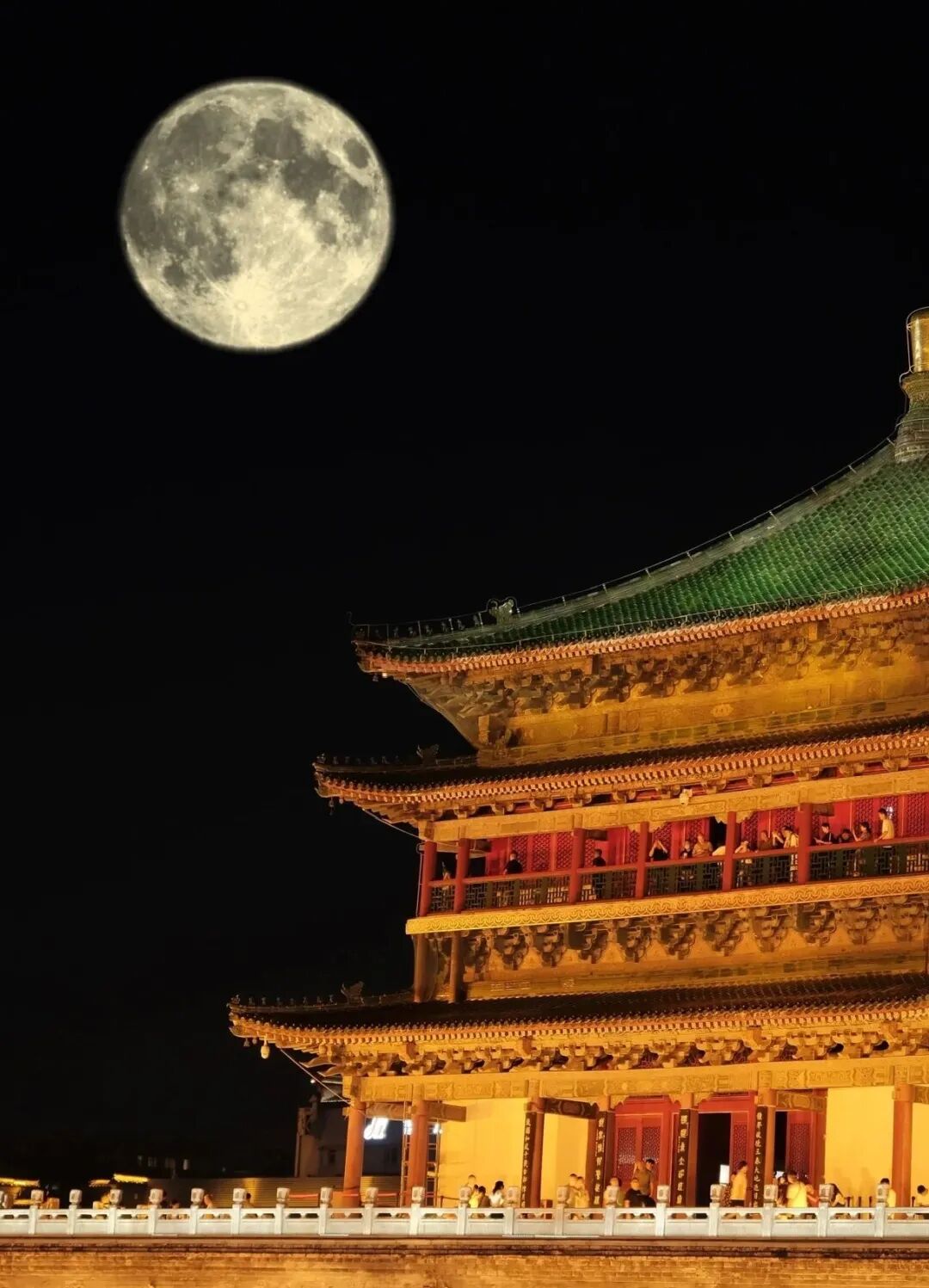
The bell tower is a brick-and-wood structure, standing 34 meters tall and covering an area of 1840 square meters. It is a typical example of Ming Dynasty architecture.
Built upon a square base, the tower features three tiers of eaves, a hip roof with four corners, and an interior staircase allowing visitors to ascend. The eaves are covered with deep green glazed tiles. Inside, the tower boasts gilded and brightly colored paintings, intricate carvings, and a gilded apex, creating a magnificent and opulent appearance.
As a highly representative example of the Ming Dynasty official architectural style in the Guanzhong region (关中地区), the Xi’an Bell Tower (西安钟楼) largely preserves the general characteristics of Ming Dynasty official architectural structures and components. It was designated as a national key cultural relics protection unit by the State Council in 1996.
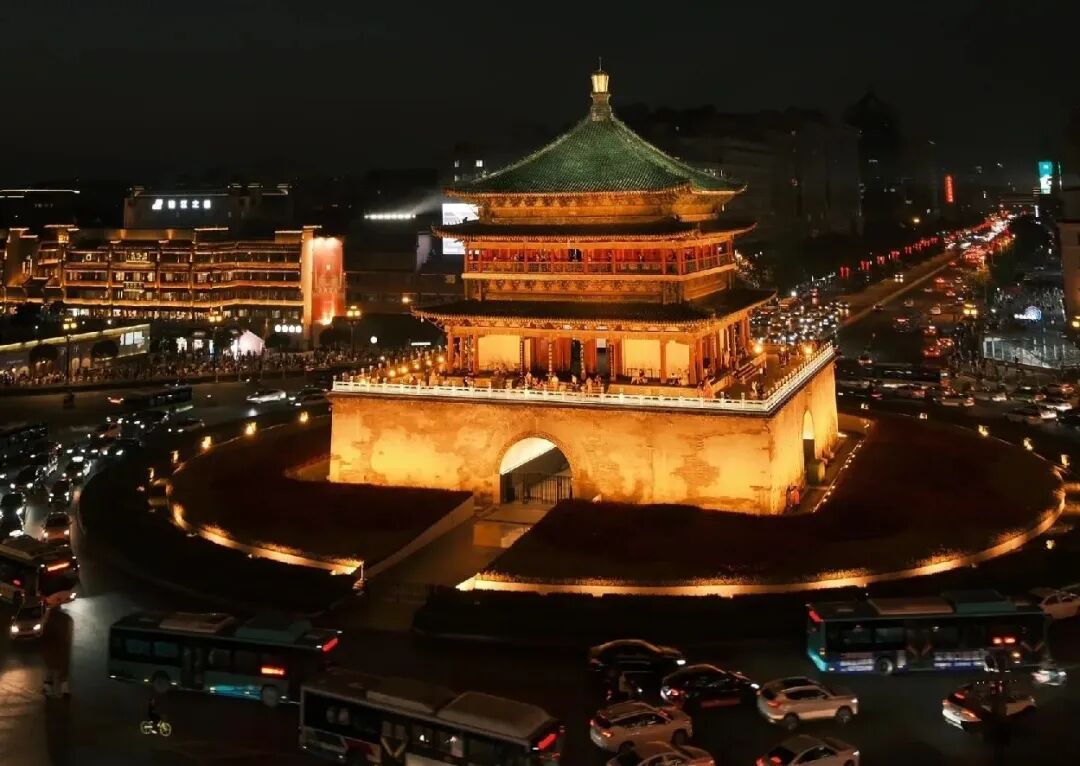
Here are the translations of the provided facts about the Bell Tower, following your instructions:
Bell Tower Fun Facts:
-
① This bell, known as the Jingyun Bell (景云钟), was cast in the second year of Emperor Ruizong’s Jingyun reign during the Tang Dynasty and is currently housed in the Xi’an Stele Forest Museum (西安碑林博物馆). The bell hanging on the Bell Tower today is a replica.
-
② The New Year’s bell chimes we hear each year are recordings of the Jingyun Bell (景云钟) broadcast by China National Radio.
-
③ The original location of the Bell Tower was at the intersection of Guangji Street (广济街), and it was moved to its current location at the crossroads of the four cardinal streets in the ninth year of the Wanli reign.
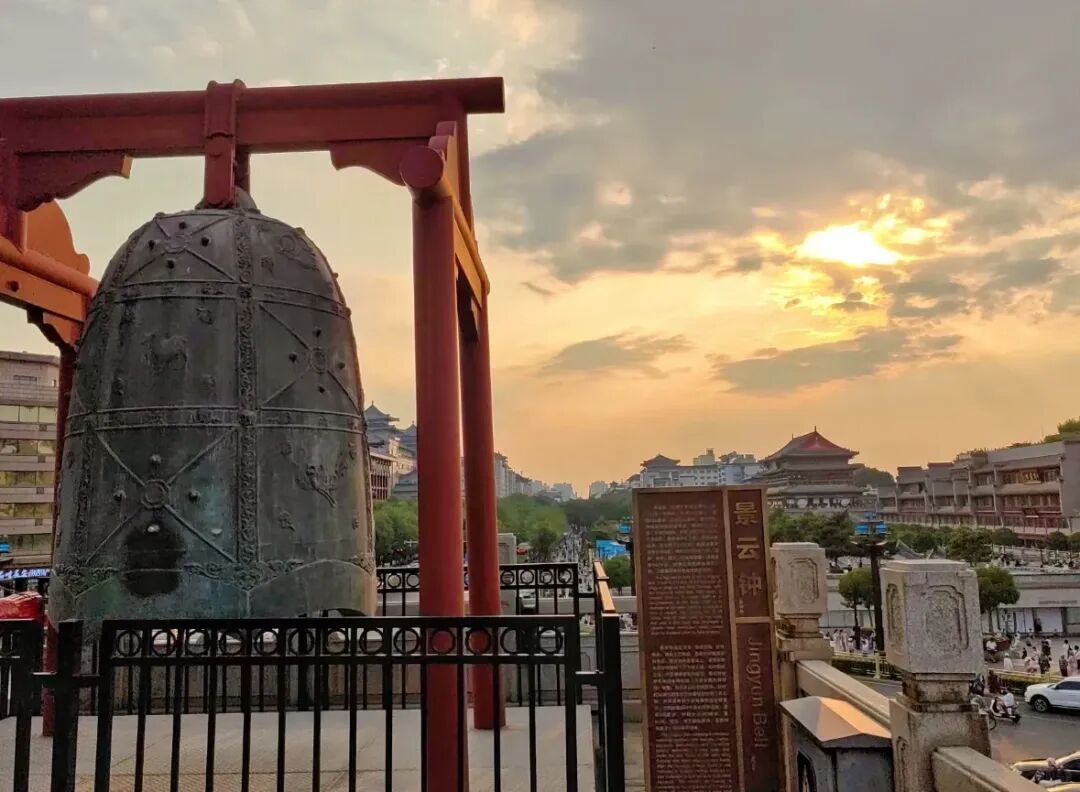
Ticket Prices & Transportation
🎫 Tickets: 30 RMB per person for the (Bell Tower), 50 RMB per person for a combined ticket for the (Bell Tower) and (Drum Tower).
🚗 Transportation:
① Self-driving: Navigate to “(Bell Tower).”
② Subway: Take Line 2 and get off at “(Bell Tower)” station, a 2-minute walk away.
③ Bus: Take buses 7, 8, 601, 611, 618, etc., and get off at “(Bell Tower)” station, a 2-minute walk away.
✅ Important Notes:
① You can purchase tickets at the entrance of the scenic area, or pre-book them online to avoid queues.
② We recommend visiting during dusk when the (Bell Tower) is illuminated by lights, offering a more beautiful view.
③ We suggest taking photos across the street from the (Bell Tower), using close-up, distant, and detail shots to capture the grandeur and intricacies of the tower.
08/Xi’an World Horticultural Expo Garden
📍 Address: Guangyuntan, Baqiao District, Xi’an City
🕰️ Opening Hours: 09:00 – 22:00
🌟 Recommendation Rating: 🌟🌟🌟🌟
The (Xi’an World Horticultural Expo Garden), formerly known as the (Xi’an World Garden Park), also known as the (Xi’an World Horticultural Expo), boasts a vast area, numerous scenic views, lush vegetation, interconnected mountains and water, and integrates culture, art, and the appreciation of rare plants and animals. It served as the venue for the 2011 (Xi’an World Horticultural Expo).
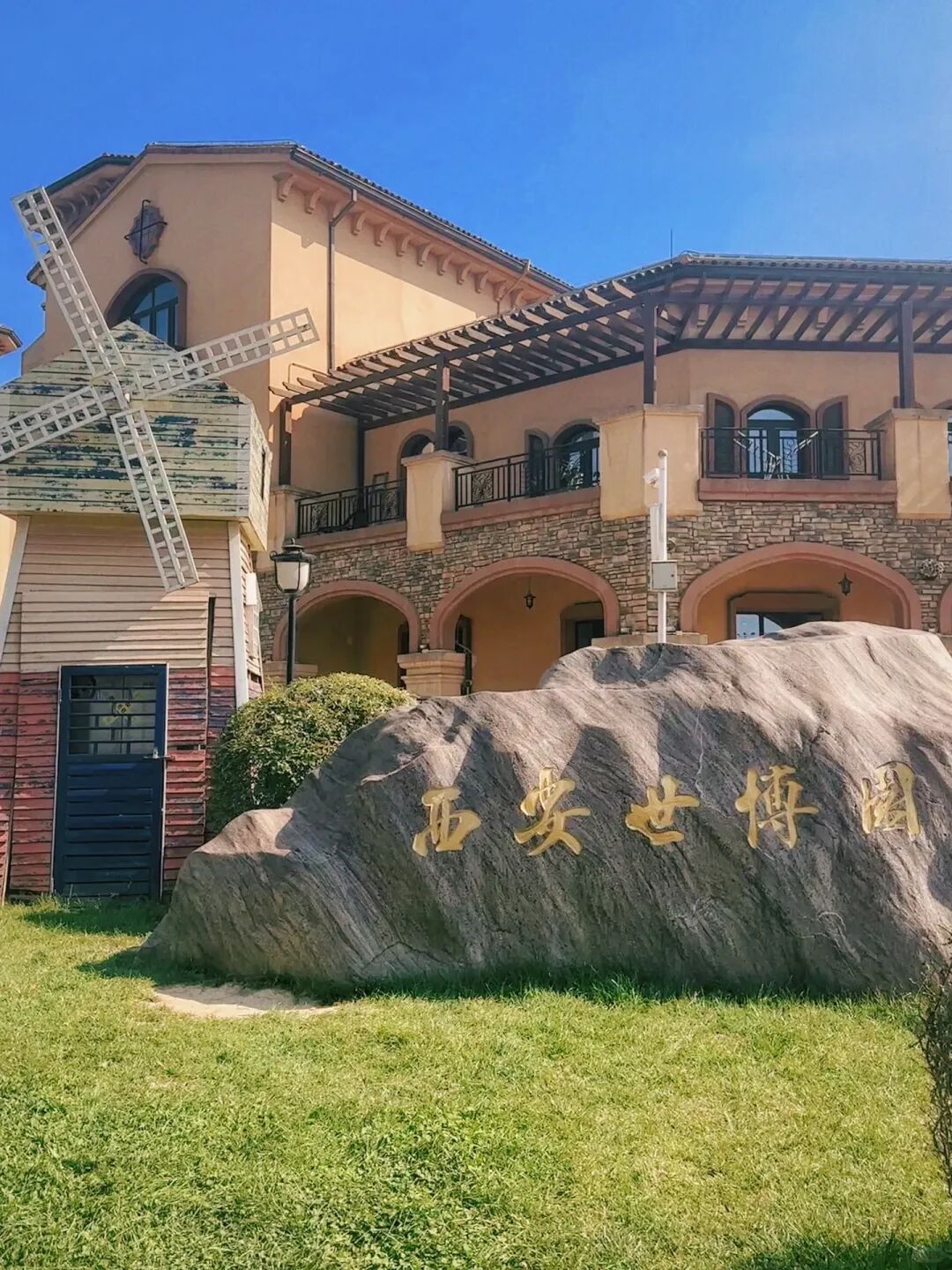
As a national 4A-level tourist attraction, the World Expo Garden (世博园) is widely known in Xi’an and has earned the nickname “ecological oxygen bar” (生态氧吧) among online users. The scenic area, a familiar place for many in Xi’an, boasts distinct attractions such as the Chang’an Tower (长安塔), Treasure Pavilion (珍宝馆), Natural Pavilion (自然馆), and Cute Pet Pavilion (萌宠馆), all of which are well worth exploring.
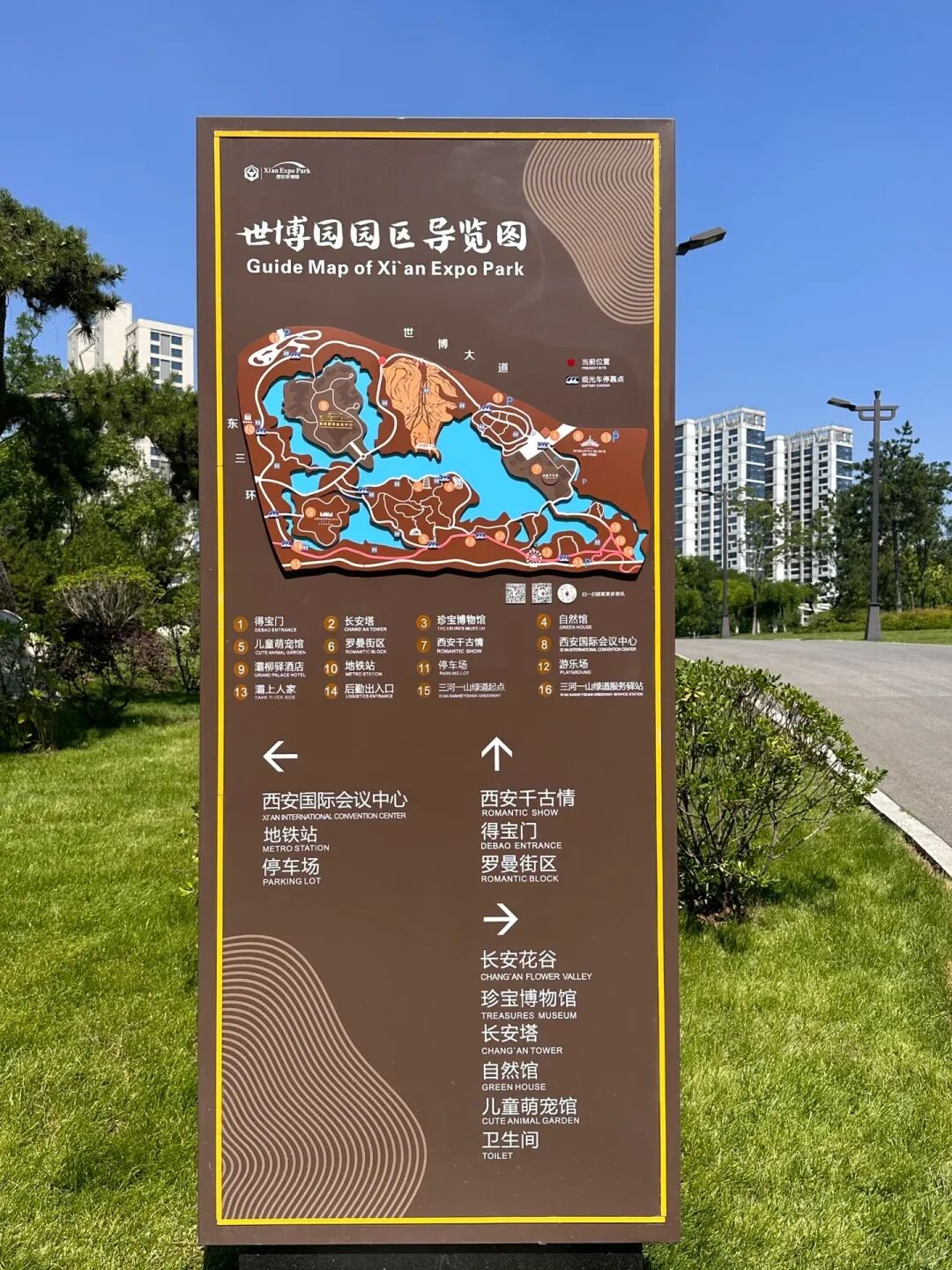
The Expo Garden is structured around five islands – Chang’an (长安) Island, Creative Island, Science & Technology Island, China (华夏) Island, and International Island – each featuring a distinct garden: Chang’an Garden (长安园), Creative Garden (创意园), Five Continents Garden (五洲园), Science & Technology Garden (科技园), and Experience Garden (体验园).
The Expo Garden embraces inclusivity and boasts unique characteristics. Key attractions include Chang’an Tower (长安塔), the Treasure Museum (珍宝博物馆), the Natural History Museum (自然馆), the Children’s Cute Pet Pavilion (儿童萌宠馆), Qinling Garden (秦岭园), Guanzhong Garden (关中园), Red Cedar Themed Garden (红豆杉主题园), and Master’s Garden (大师园). Furthermore, visitors can explore the World Gardens, Domestic Gardens, and Provincial Gardens.
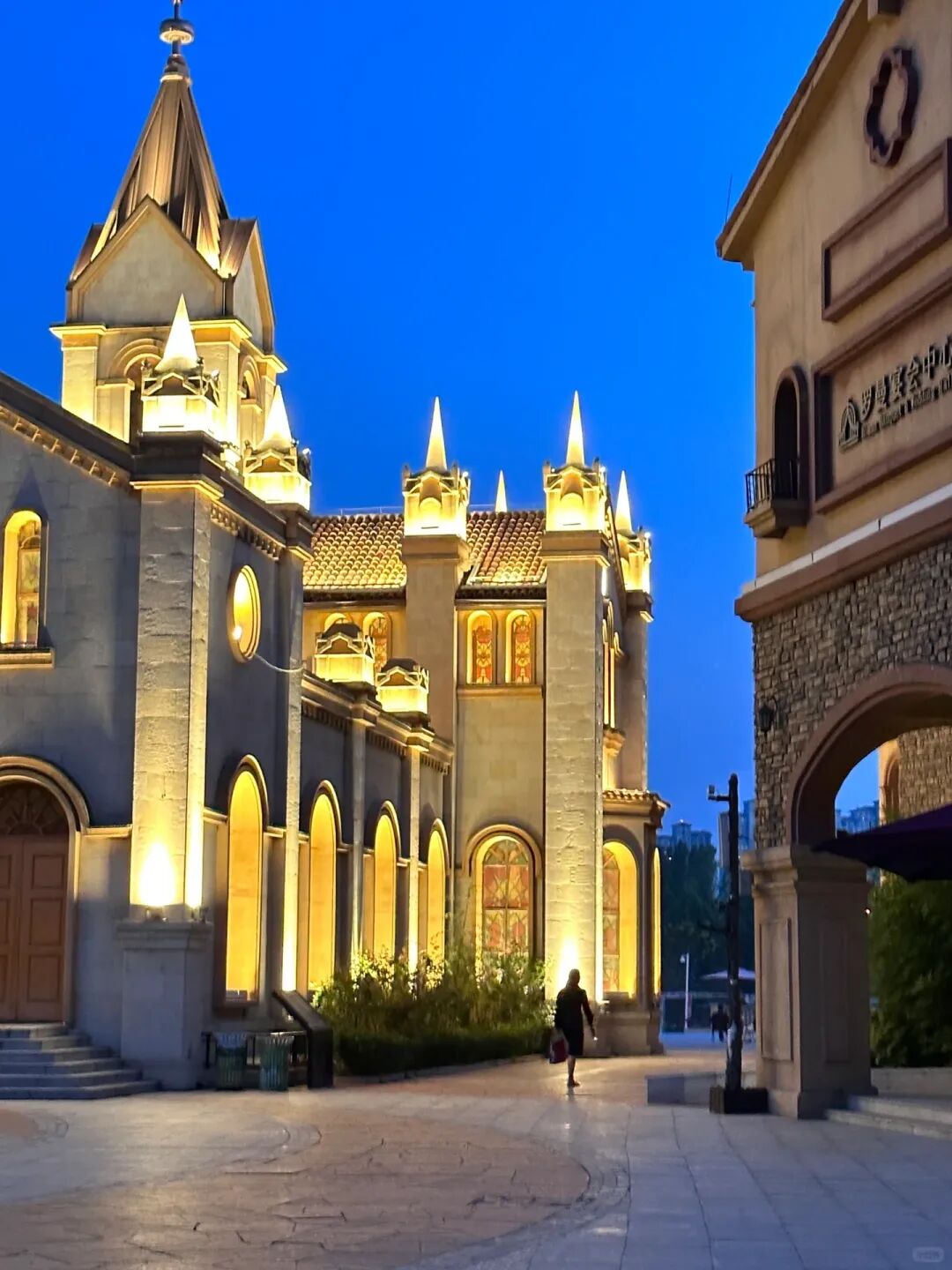
Here’s a natural and fluent English translation of the provided text, adhering to your rules and formatted with Markdown:
The Great Tang Tower: A Landmark of the Xi’an World Expo Garden
The Great Tang Tower (长安塔) stands as the iconic landmark of the (Xi’an) World Expo Garden. With a height of 99 meters, it utilizes a steel structure and glass construction, featuring seven visible floors, six hidden floors, and one underground level. It exhibits characteristics typical of Tang Dynasty wooden pagodas. The tower’s design incorporates a projecting eaves above a bottle-shaped base, with each level progressively narrowing, highlighting the distinctive cultural features of Xi’an.
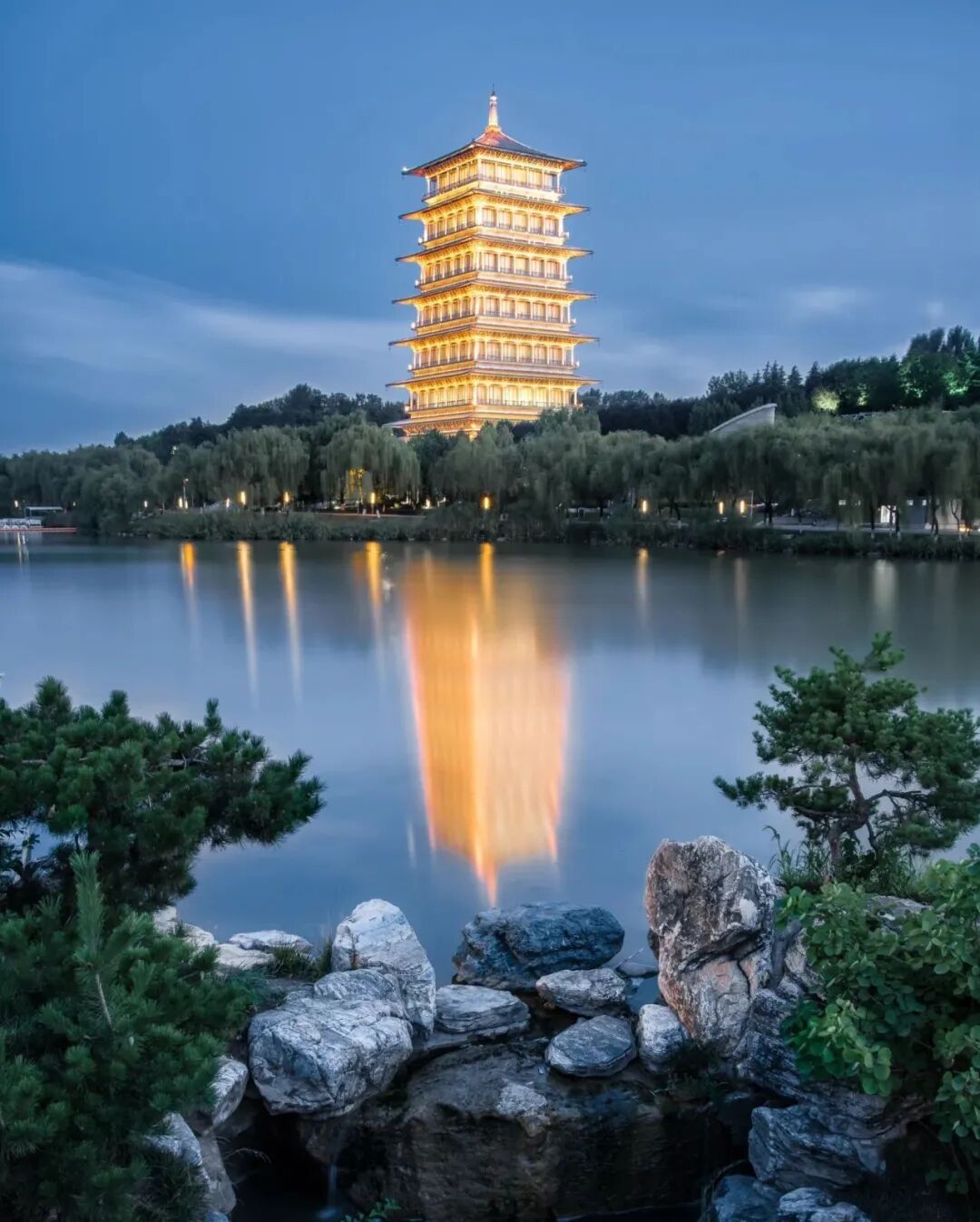
🎫 Tickets: Free. Sightseeing Bus: ¥30 per person
🚗 Transportation:
① Subway: Take Line 3 to Xianghu Bay Station and exit from Exit A2. Follow the signs for approximately 200 meters (4 minutes) to reach the side gate of the Expo Garden.
② Bus: 246, 262, 297, 47,灞浐2号线 (Xi’an Qu’an Canal Line 2), 灞浐3号线 (Xi’an Qu’an Canal Line 3), 灞浐7号线 (Xi’an Qu’an Canal Line 7), 灞浐8号线 (Xi’an Qu’an Canal Line 8)
09/ 回民街 (Huimin Street)
Address: Xi’an City, 回民街 (Huimin Street)
Opening Hours: All Day
Recommended Rating: 🌟🌟🌟🌟
Historically, 回民街 (Huimin Street) was once the site of Qing Dynasty government offices. With the reopening of the Silk Road, many Islamic merchants came to Chang’an (长安) for business, study, and government service. These individuals were Muslims. Following their customs and with the support of the Tang Dynasty government, a mosque was established. Through generations of growth and development, it gradually formed what is now 回民坊 (Huimin Fang), which is today’s 回民街 (Huimin Street)!
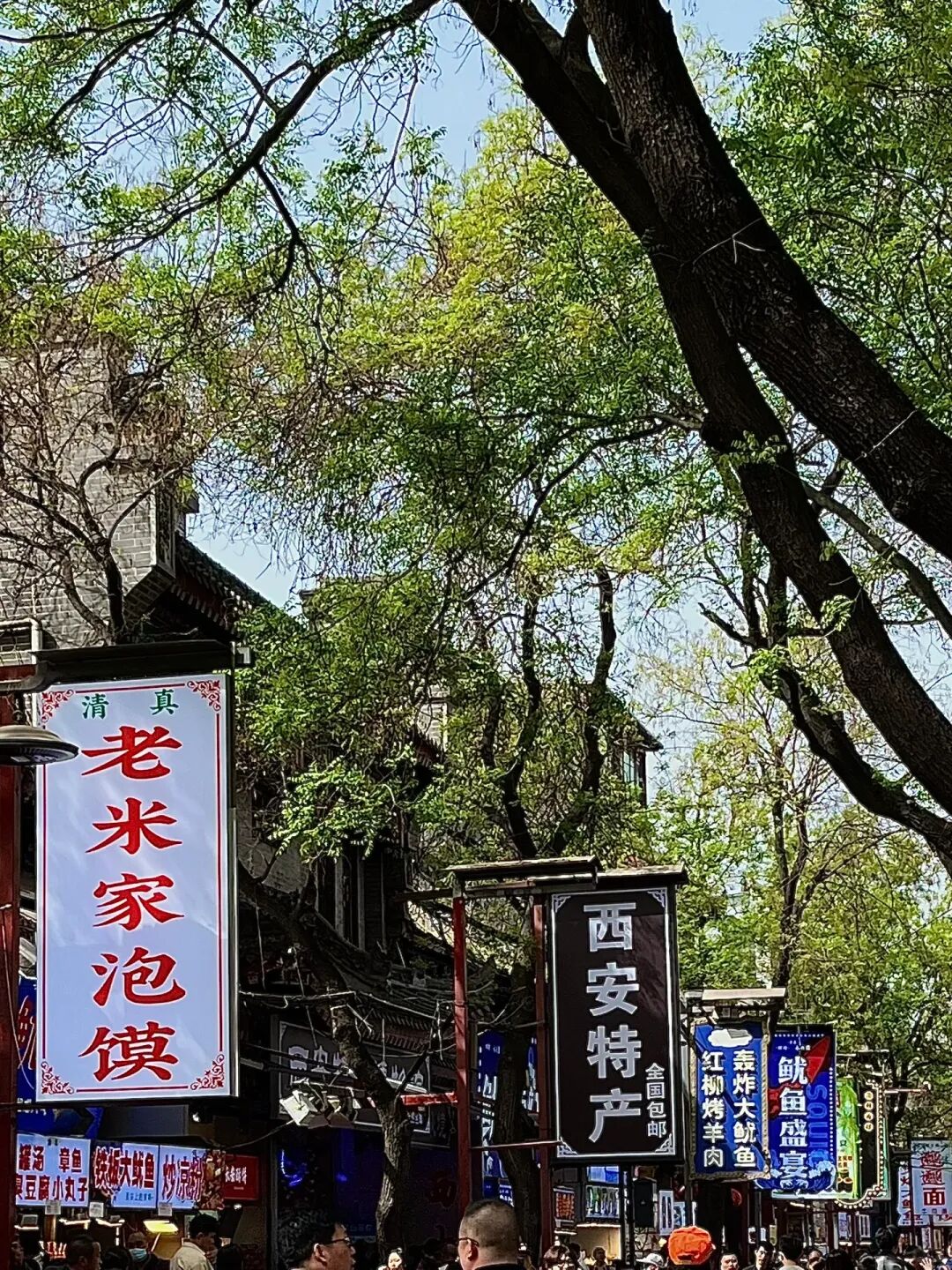
Here’s a natural and flowing English translation of the provided text, adhering to your rules:
Muslim Quarter isn’t a single road but rather a collective term for the multiple streets comprising the area, consisting of (Beiyuanmen), (Huajuexiang), (Xiyangshi), and (Dapiyuan). Crossing the Drum Tower leads you into the Muslim Historic Quarter. The area is home to ten mosques of varying sizes and ages, the most famous of which is the (Huajuexiang) Grand Mosque. Currently, over 60,000 Hui Muslim residents live within the quarter, maintaining their original religious traditions and lifestyle.
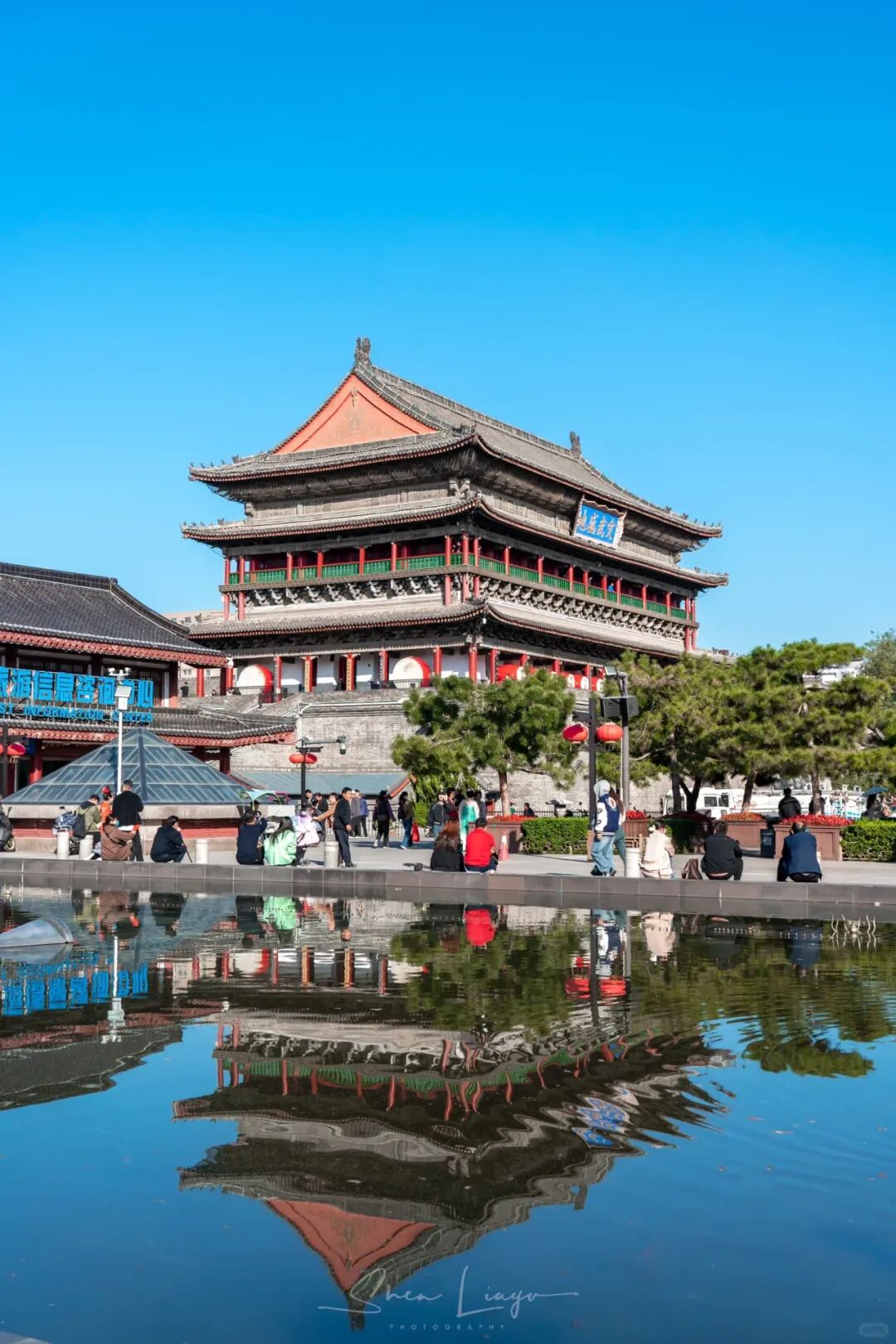
Here’s a natural and fluent English translation of the provided text, adhering to your rules and formatted in Markdown:
Walking through the neighborhood, one encounters commercial establishments everywhere showcasing a striking blend of Ming and Qing architecture with Islamic architectural styles. You’re surrounded by (民族服饰) ethnic clothing, handicrafts, (清真副食) halal food products, restaurants, and (回民小吃店) Hui Muslim snack shops, all radiating a distinctively halal atmosphere. The streets are paved with blue stone, and the shops are arranged in a pleasing manner, with wooden plaques hanging beneath the blue tile eaves, exuding a rich and ancient charm characteristic of the Guanzhong region. It’s filled with the humanistic aura of the Qin, Han, and Tang dynasties.
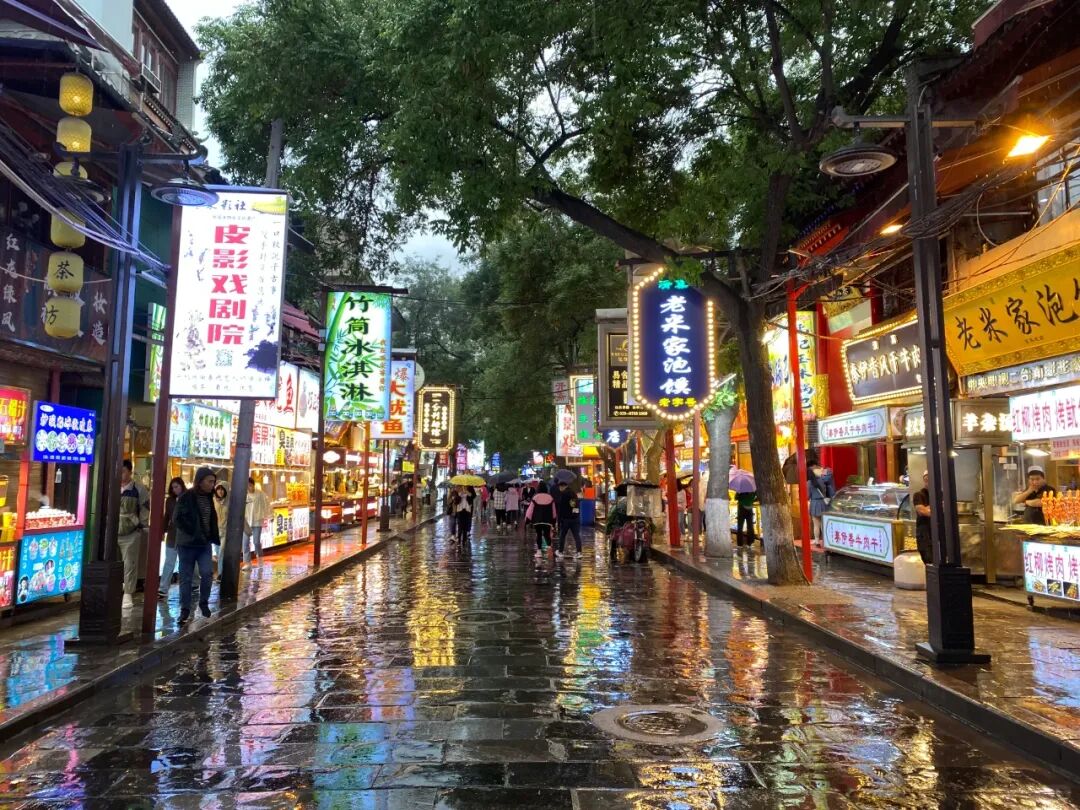
🎫 Tickets: Not required
🚗 Transportation:
① Self-driving: Navigate to “Huimin Street” (回民街)
② Subway: Take Line 1 to “Beida Street” (北大街) B southwest exit, or Line 2 to “Bell Tower” (钟楼) 9th exit, walk 500 meters, or Line 6 to “Guangji Street” (广济街) D1 exit, walk 500 meters.
③ Bus: Take routes 222 or 622 to “Guangji Street” (广济街) and walk 400 meters.
✅ Note:
① If you are visiting for the first time, be sure not to miss the North Gate (北院门) north of the Drum Tower. This street represents Huimin Street and is the most frequented area for tourists.
② While enjoying the delicious food, please take care of your digestive system! Xi’an’s cuisine tends to be oily and spicy, so it’s recommended to sample moderately and avoid overindulging.
10/Huaqing Palace (华清宫)
Address: No. 38, Huaqing Road, Huaqing Palace, Lintong District, Xi’an City
Opening Hours: 7:30 AM – 6:00 PM
Recommended Index: 🌟🌟🌟🌟
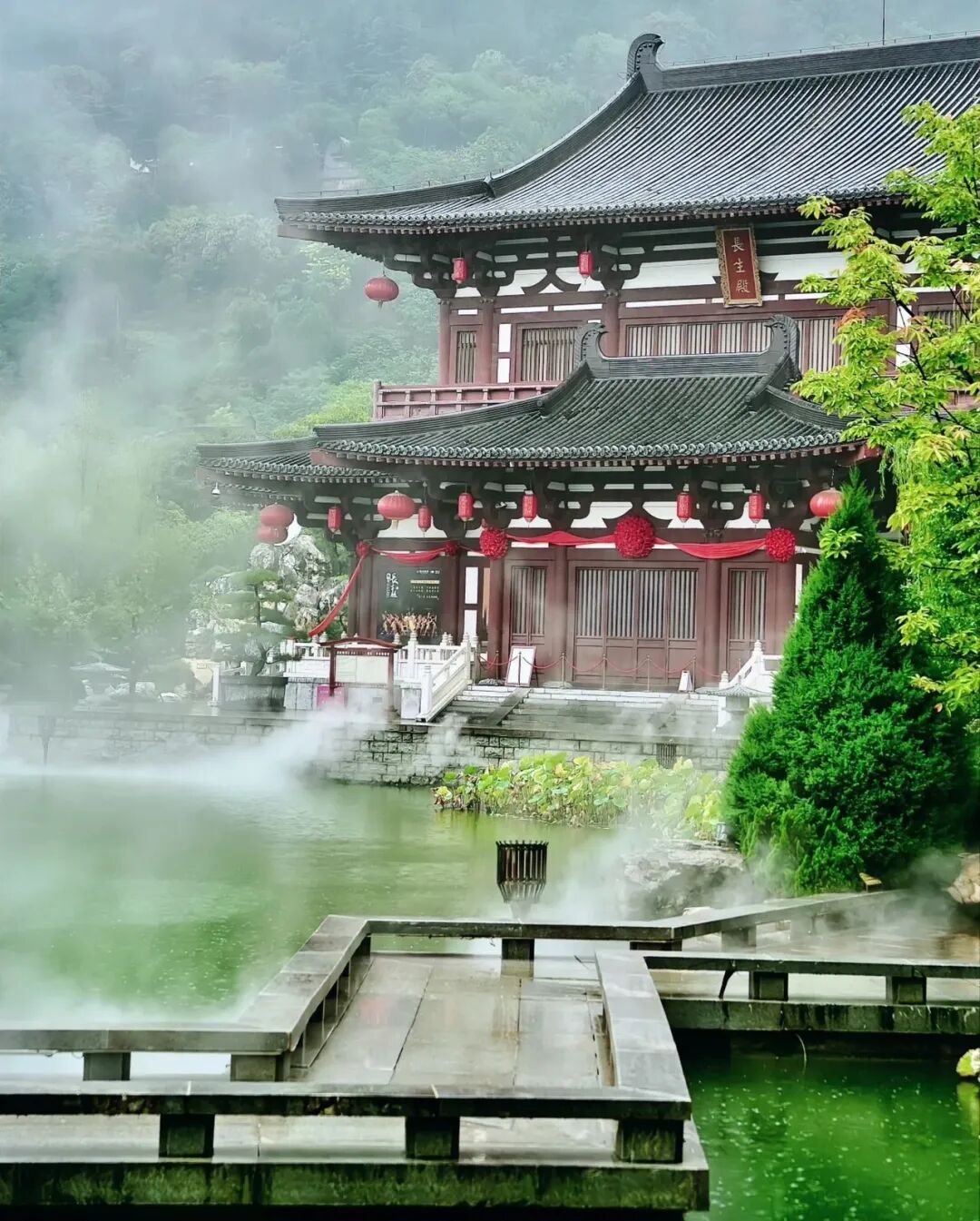
Huaqing Palace (华清宫), as one of Xi’an’s cultural landmarks, is located in Lintong District, Xi’an City. It is backed by Mount Li, faces the Weihe River, and served as a royal retreat for Tang Dynasty emperors. It is renowned for its association with the love story of Emperor Xuanzong and Yang Guifei, and as the site of the “Xi’an Incident.”
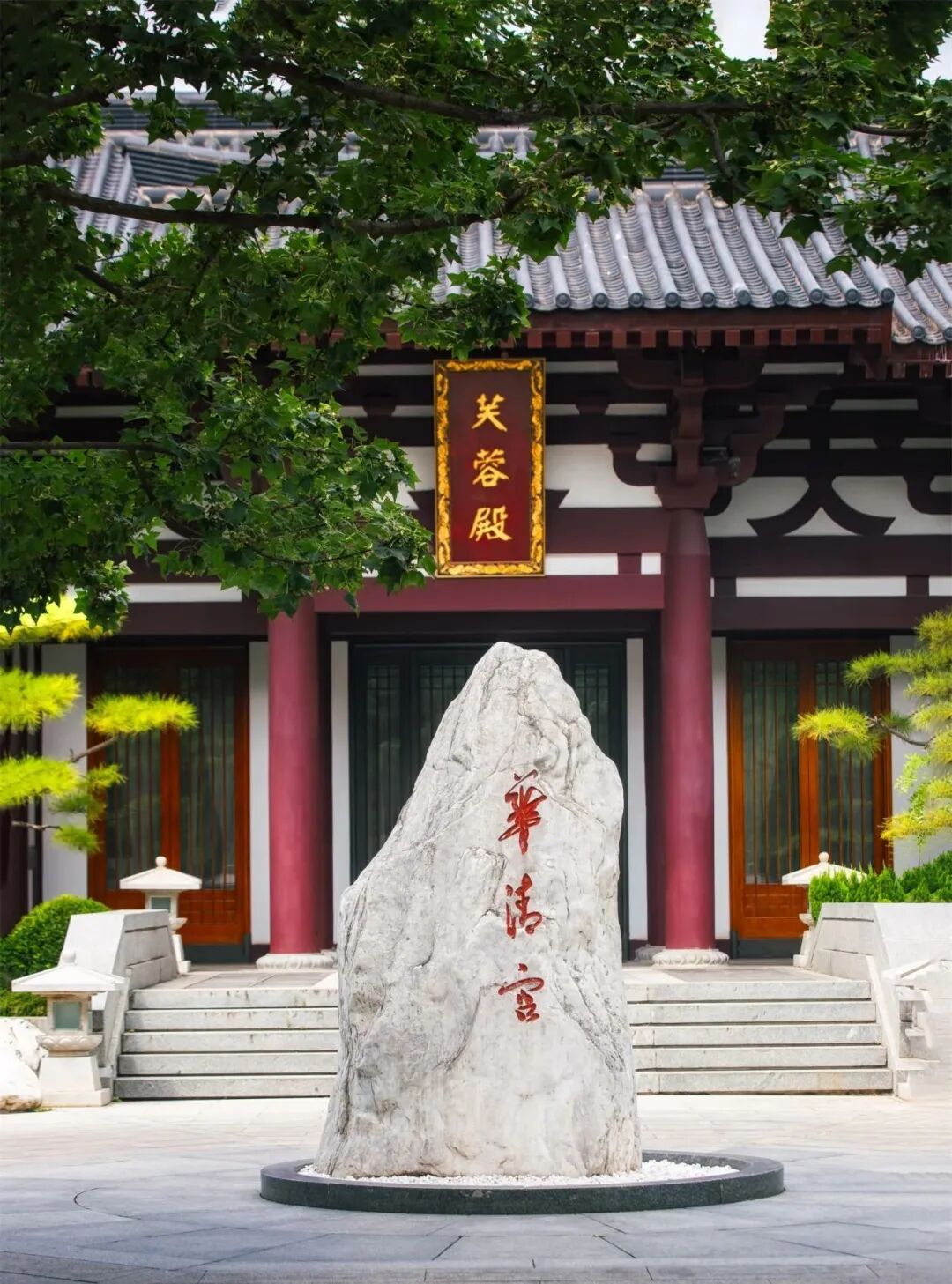
华清宫 (Huáqīng Gōng) Scenic Area was built upon the historical site of the Tang Dynasty’s (唐朝) Huaqing Palace, becoming a landmark scenic area representing Tang Dynasty culture and tourism in China. In recent years, the scenic area has actively explored the integration of culture and tourism, developing immersive performances. The large-scale historical dance drama Chang Hen Ge (长恨歌) utilizes Mount Li (骊山), palace structures, and the lake and pavilions as a backdrop, fusing sound, light, electricity, and natural landscapes to narrate a love story from a thousand years ago, guiding audiences to experience the splendor of the Tang Dynasty.
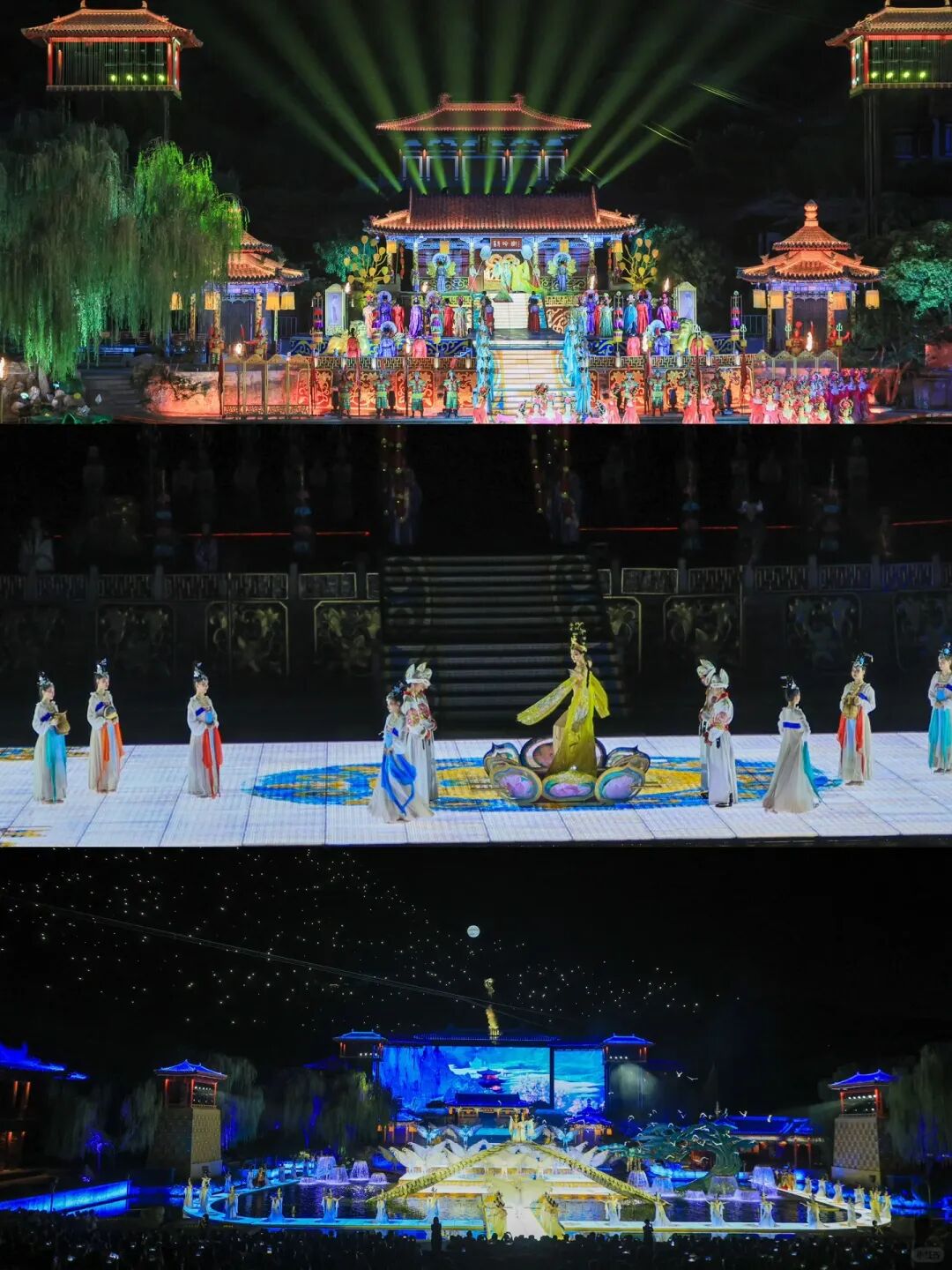
🎫 Tickets: ¥120 per person
🚗 Transportation:
① Bus: You can take special route 5 (bus 306), bus 915, or bus 914.
② Subway: Take Metro Line 9 to Huaqingchi Station, exit from C, and it’s a 3-minute walk to the scenic area.
✅ Notes:
① It’s recommended to visit Huaqing Palace during the day and watch the “Royal Concubine’s Eternal Sorrow” (长恨歌) at night. You’ll truly appreciate how the daytime gardens transform into a spectacular sound and light show stage.
② The Huaqing Guoyu Hotel (华清御汤酒店) inside Huaqing Palace offers a millennium-old hot spring experience just like Yang Guifei’s. Rooms have private hot springs, and there’s also a public hot spring – a taste of imperial treatment worth experiencing.
Xi’an Cuisine
Xi’an’s food culture is world-renowned and a definite must for any foodie visiting the city. It’s affordable, authentic, and delicious! Don’t forget to sample the local delicacies.
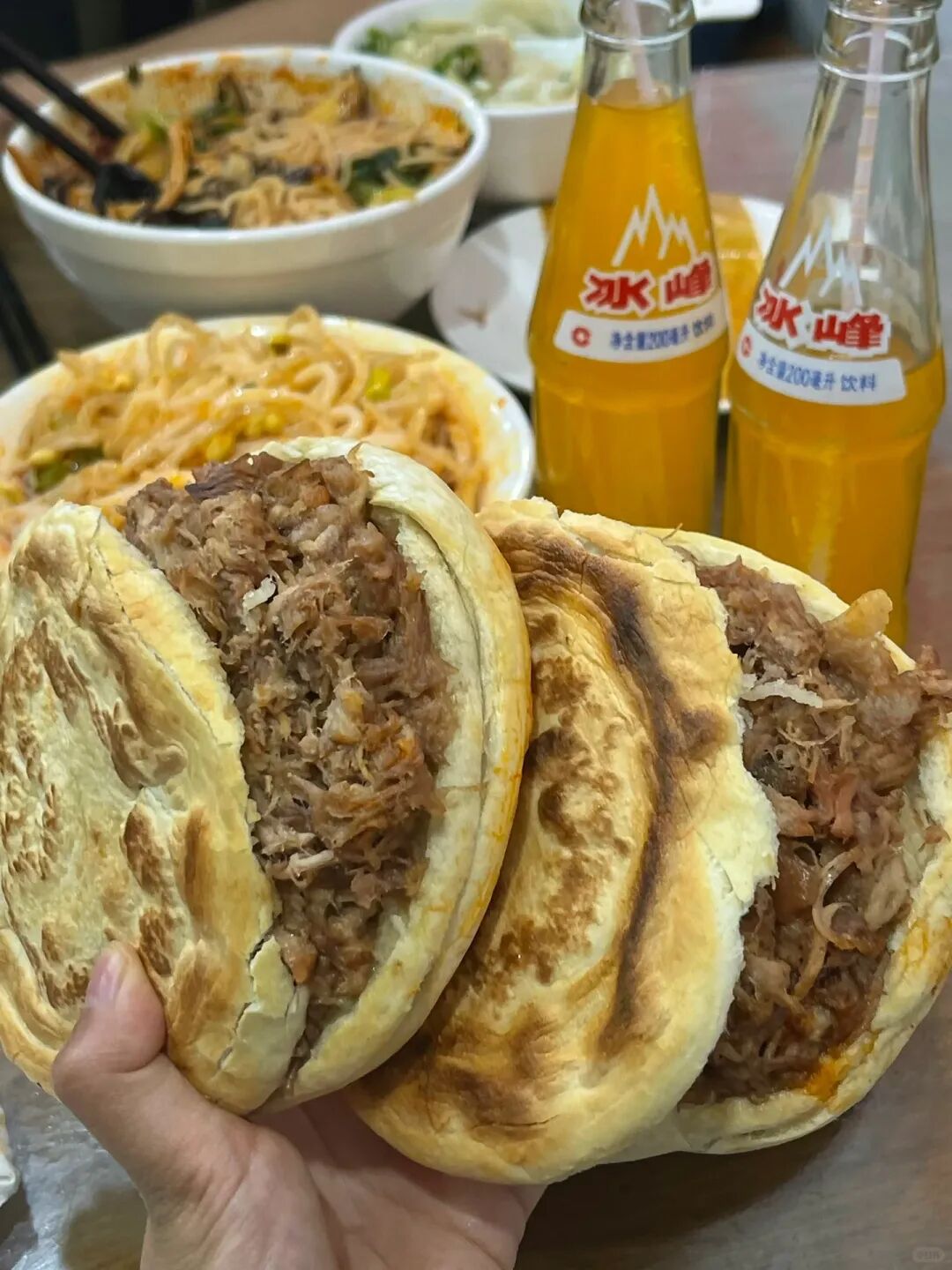
01 Rou Jia Mo (肉夹馍): Rou Jia Mo is a traditional Chinese specialty. The name translates to “meat-filled buns.” In the Shaanxi region, you’re likely to find “Laze Juice Rou Jia Mo” (腊汁肉夹馍) using Baiji Mo, while in Western Baoji, there’s a meat-flavored Rou Jia Mo with vinegar. Tongguan’s Tongguan Rou Jia Mo (潼关肉夹馍) is different – the bun has a golden-yellow exterior with clear stripes, a layered interior, puffy texture, crispy crust and tender inside. It’s baked to perfection. Served hot, it’s filled with cold meat, creating a crispy, fragrant, and satisfying combination.
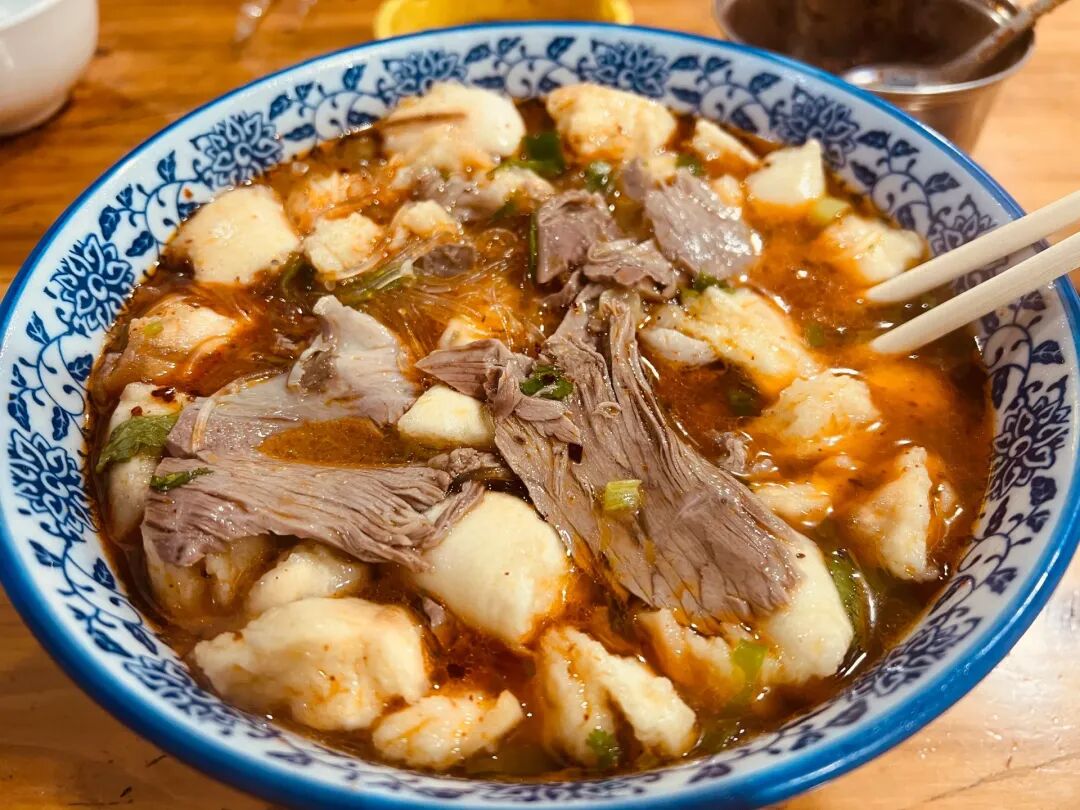
02 Yangrou Paomo (羊肉泡馍): A Culinary Gem of Northwest China
Yangrou Paomo, commonly known as Yangrou Pao (羊肉泡) or Paomo (泡馍), was historically referred to as “Yanggeng” (羊羹), a renowned delicacy of Northwest China. It is particularly famous in Xi’an, Shaanxi province, where the beef and lamb versions are highly celebrated. The renowned Song dynasty poet Su Shi (苏轼) famously wrote, “The cuisine of Longzhou has bear meat; the cooking of Qin is known for Yanggeng.” (陇馔有熊腊,秦烹唯羊羹).
The preparation of Yangrou Paomo is meticulous, resulting in a dish rich in ingredients and flavor, with tender meat, a robust and savory broth, a satisfying richness without being greasy, and a wealth of nutrients. Its enticing aroma stimulates the appetite, and the aftertaste is truly unforgettable. Because it is warming and filling, it has long been a favorite among the people of Xi’an and other regions of Northwest China. Foreign visitors to Shaanxi often seek out this dish, eager to experience its unique flavor. Beef and lamb Yangrou Paomo has become the “total representative” (总代表) of Shaanxi’s famous cuisine.
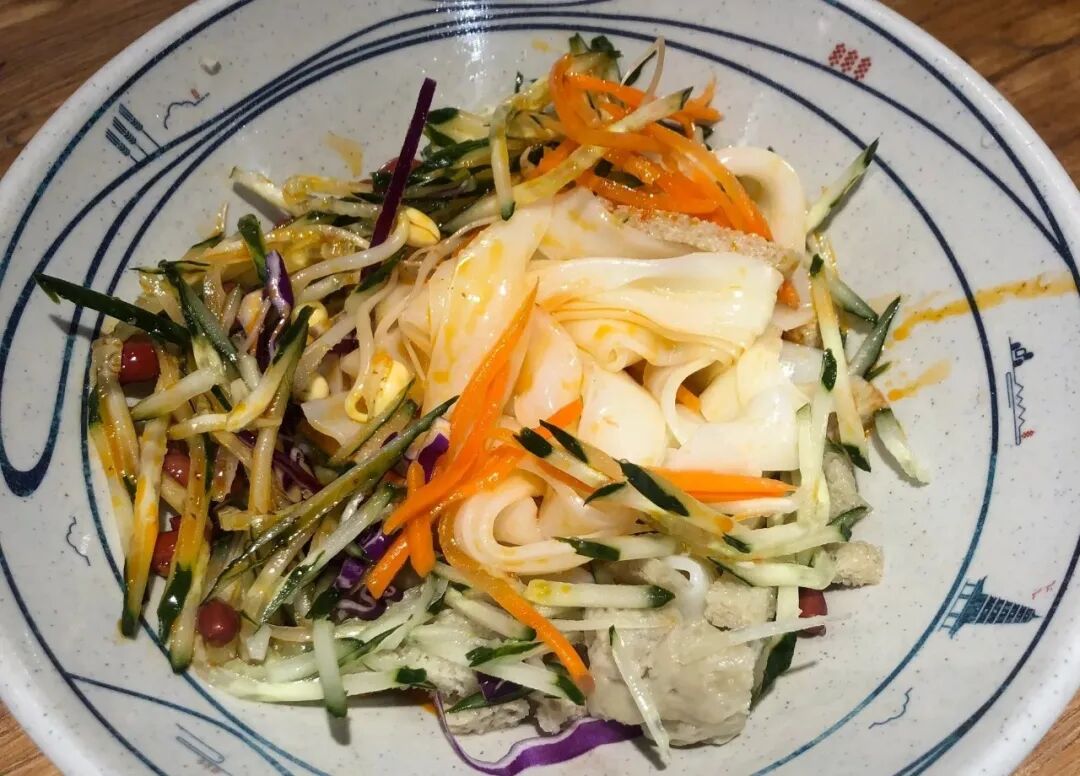
Shaanxi Liangpi (陕西凉皮) – A Traditional Delicacy
Shaanxi Liangpi (陕西凉皮) is a well-loved traditional specialty snack. It’s primarily made with wheat flour, though sometimes rice flour or other starches are used. It’s typically eaten cold (though in the Hanzhong (汉中) region, hot versions are more popular), and boasts a wide variety of types and preparation methods, each with unique flavor combinations.
Liangpi (凉皮) has a long history, with legends tracing its origins back to the Qin Shi Huang (秦始皇) period. Common variations include sesame-paste Liangpi (麻酱凉皮), Qinzhen Rice Noodles (秦镇米皮), Hanzhong Wheat Noodles (汉中面皮), Qishan Rolled Noodles (岐山擀面皮), and Mianjin Liangpi (面筋凉皮).
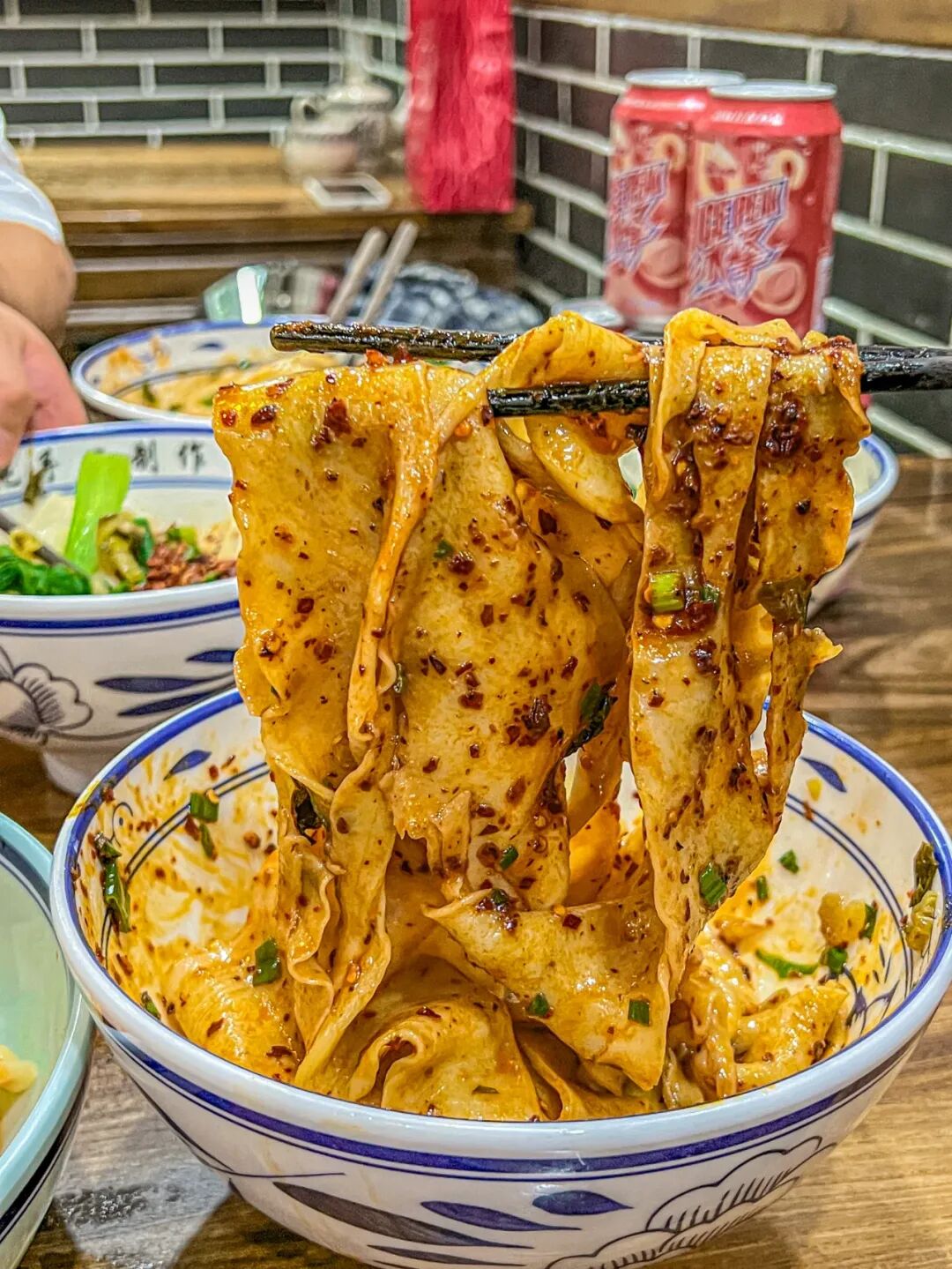
04. Oil-Poached Spicy Chili (Biang Biang) Noodles: (油泼辣子biangbiang面)
Oil-Poached Spicy Chili (Biang Biang) Noodles (油泼辣子biangbiang面) are a traditional noodle dish from the Guanzhong region of Shaanxi province, a testament to Han Chinese culinary heritage. The name originates from the biang, biang sound produced during the kneading process. The noodles are crafted using flour milled from Guanzhong wheat, hand-pulled into long, wide, and flat strands. They are served with a broth seasoned with soy sauce, vinegar, monosodium glutamate, Sichuan peppercorns, and other flavorings. The noodles are then carefully lifted from the broth and drizzled with hot vegetable oil to complete the dish.
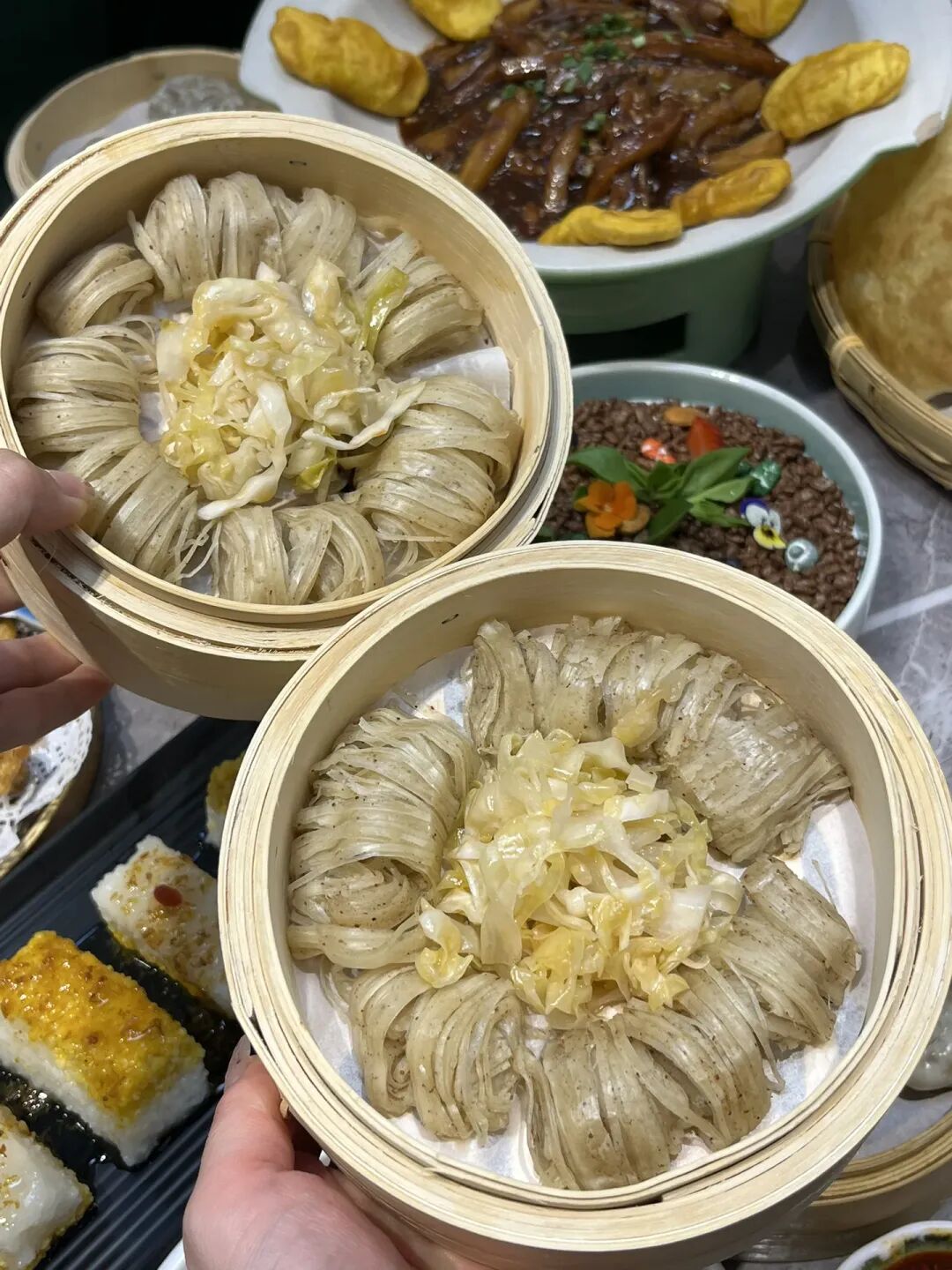
Golden Thread Oil Tower (金线油塔): A Culinary Treasure from Sanxian (三原)
The Golden Thread Oil Tower (金线油塔) is a renowned traditional snack from the Sanxian (三原) area of Shaanxi province. Its defining characteristics are its numerous, delicate layers and a light, non-greasy texture. The name originates from its unique appearance: “it resembles golden threads when lifted, and looks like a pine tower when placed down.”
The recipe is detailed in the Qing Dynasty’s “素食说略” (Sùshí Shuō Lüè – Vegetarian Culinary Sayings). Legend has it that it was created by a cook in the household of Duan Wenchang (段文昌), a minister of state during the Tang Dynasty. Originally named “Oil Tower (油塌 – Yóu Tā),” the snack underwent improvements during the Qing Dynasty. It utilizes premium flour and pork lard as ingredients, increases the layers of the pastry, changes the form from flat cakes to a tower shape, and switches the cooking method from baking to steaming. The name was then changed to “Golden Thread Oil Tower (金线油塔 – Jīnxiàn Yóu Tā),” solidifying its status as a superior delicacy.
When the Oil Tower (金线油塔) is steamed and removed from the steamer, it is traditionally lightly beaten and shaken to loosen the layers, and then placed on a plate. It is typically served with scallions and sweet bean paste (甜面酱 – Tiánmiànjiàng), creating a uniquely flavorful experience.
Hulu Tou: A Xi’an Delight
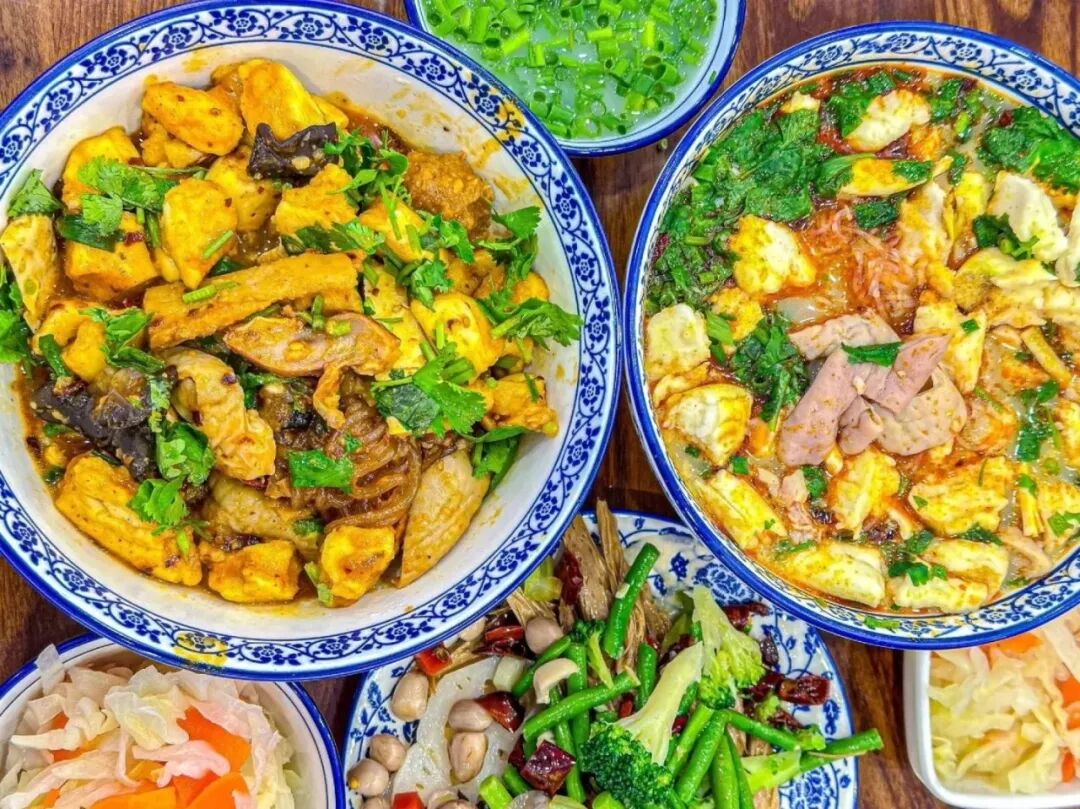
(葫芦头) Hulu Tou is a traditional specialty snack from Xi’an, Shaanxi province. It originates from “Jian Bai Chang” (煎白肠), a type of street food popular during the Northern Song Dynasty. The name “Hulu Tou” (葫芦头) comes from the fact that pig intestines, a key ingredient, are rich in fat and have a shape resembling a gourd (hulu).
The basic ingredients of Hulu Tou are pig intestines and pig stomach. When enjoyed, customers first break up pieces of mo (馍, a type of unleavened flatbread), and the chef then arranges the pig intestines and stomach alongside chicken, sea cucumber, squid, and other ingredients on top of the crumbled mo. The dish is then soaked several times in simmering bone broth and topped with cooked pork fat and greens. It’s typically served with candied ginger (tang蒜) and chili sauce to complement the rich, tender flavor, avoiding any sense of greasiness.
Legend has it that the renowned Tang Dynasty physician, Sun Simiao, shared his method for cooking pig intestines and stomachs with the owner of a restaurant in Chang’an (长安), gifting them a medicinal gourd to use for seasoning. The restaurant owner improved the preparation method based on Sun Simiao’s guidance, and Chang’an’s “Hulu Tou” gained prominence and has been passed down through the generations for a thousand years.
Xi’an Transportation (西安交通)
This phrase refers to the transportation system of Xi’an (西安), a major city in China. It encompasses various modes of travel within and to/from the city. This includes, but is not limited to:
- Public Transportation: Buses, subways (地铁 – Dìtiě), and taxis.
- Air Travel: Xi’an Xianyang International Airport (西安咸阳国际机场 – Xi’ān Xiányáng Guójì Jīchǎng).
- Rail Travel: High-speed trains and conventional trains connecting Xi’an (西安) to other cities in China.
- Road Transport: Buses, cars, and taxis for local travel and access to surrounding areas.
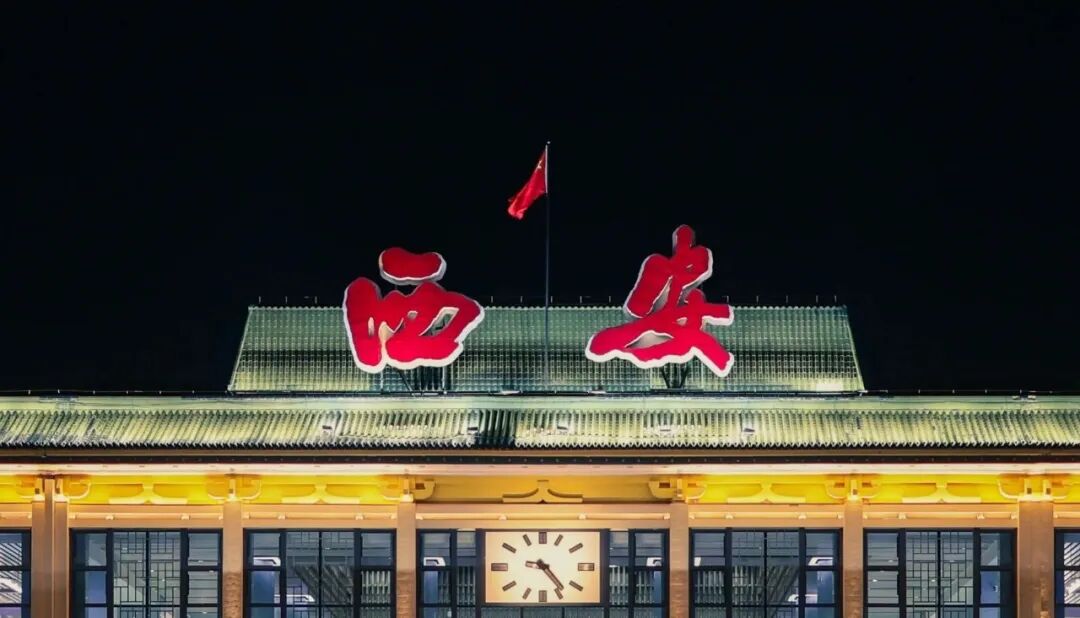
Getting Around Xi’an: Transportation Guide
Here’s a breakdown of transportation options for getting to and around Xi’an:
From Xi’an Xianyang International Airport (咸阳国际机场) to the City Center (钟楼)
-
Airport Shuttle Bus: Operates from 7:00 AM to 9:00 PM, departing every 30 minutes. Departures are based on filling the bus, and the journey to (钟楼) takes approximately 70 minutes. After 9:00 PM, consider the “Shouhang Night Snack Line 1” bus.
-
Metro: Take the Airport Express Line to North Passenger Station (北客站), then transfer to Line 4 to Administrative Center (行政中心) station, and finally transfer to Line 2 to (钟楼) station.
From Xi’an Railway Station/High-Speed Rail Station (高铁/火车站) to the City Center (钟楼)
-
Xi’an Railway Station (西安站): Take Metro Line 2 directly to (钟楼) station, or take a taxi (approximately 20 RMB).
-
Xi’an South Railway Station (西安南站): Take bus 725 to transfer to Metro Line 2 (note: this station is relatively remote).
-
Xi’an North Railway Station (西安北站): Take Metro Line 1 to transfer to Metro Line 2, disembarking at (钟楼) station.
Transportation within Xi’an City
-
Metro: The Xi’an metro system is convenient and avoids traffic congestion. Operating hours are generally from 6:00 AM to 11:00 PM, with fares ranging from 2 to 8 RMB.
-
Bus: Buses are prone to traffic delays, especially during rush hour and peak tourist seasons.
-
Taxi: Daytime base fare is 9 RMB, and nighttime base fare is 10 RMB. Xi’an taxis are green – be sure to avoid unlicensed (“black”) taxis.
-
Mobile Payment Codes:
- For buses, search for “Chang’an Tong Bus Riding Code” (长安通公交乘车码).
- For the metro, search for “Xi’an Metro Riding Code” (西安地铁乘车码) on your Alipay account.